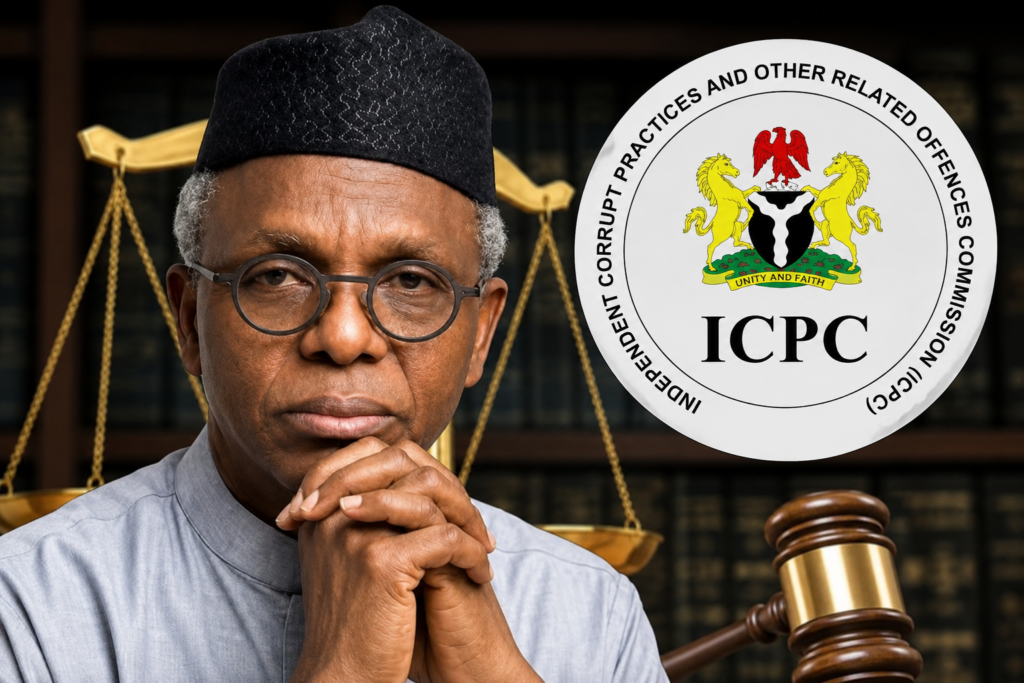
Former Kaduna State Governor Nasir Ahmad El-Rufai has remained one of Nigeria’s most influential and controversial political figures long after leaving office. Once celebrated by supporters as a reform-minded administrator and criticised by opponents for his uncompromising style of governance, El-Rufai now finds himself at the centre of one of the country’s most closely whyatched legal and political stories.
What began as reports of investigations by anti-corruption agencies has evolved into multiple court proceedings, public debates over accountability, and renewed scrutiny of Nigeria’s capacity to investigate and prosecute politically exposed persons. The case has generated intense public interest because it touches on broader questions that extend far beyond one individual: Can Nigeria’s anti-corruption institutions pursue high-profile cases without political interference? Can allegations involving former senior public officials be tested fairly through the courts? And what does the unfolding legal process mean for public confidence in the rule of law?
While public discussion surrounding El-Rufai’s legal challenges has often been shaped by politics and social media commentary, the facts are more nuanced. Investigations, allegations, court filings, and judicial proceedings each represent different stages of the legal process. Under Nigerian law, allegations alone do not establish guilt, and every defendant is entitled to the presumption of innocence until proven guilty by a competent court.
This report examines the chronology of the investigations, the nature of the allegations, the roles of the Economic and Financial Crimes Commission (EFCC) and the Independent Corrupt Practices and Other Related Offences Commission (ICPC), the court proceedings that have followed, and what Nigerians should expect as the legal process continues.
From Governor to Subject of Investigation
Nasir El-Rufai served as Governor of Kaduna State from 2015 to 2023 after previously serving as Minister of the Federal Capital Territory under former President Olusegun Obasanjo. Throughout his political career, he built a reputation for implementing ambitious infrastructure projects, restructuring public institutions, and introducing reforms that attracted both praise and criticism.
His administration invested heavily in roads, schools, healthcare facilities, urban renewal, and public sector reforms. However, questions regarding public procurement, state borrowing, contract awards, and financial management also surfaced during and after his tenure.
Following the transition to a new administration in Kaduna State, petitions reportedly submitted by individuals and groups called for investigations into aspects of the previous government’s financial decisions. Those petitions eventually attracted the attention of anti-corruption agencies, setting in motion a series of investigative processes that would later become national news.
Understanding the Roles of the EFCC and ICPC
Public discussion has often blurred the distinction between the EFCC and the ICPC, even though the two agencies have separate legal mandates.
The EFCC is primarily responsible for investigating and prosecuting economic and financial crimes, including money laundering, advance fee fraud, illicit financial flows, and financial misconduct involving public officials.
The ICPC, on the other hand, focuses on corruption-related offences, abuse of public office, violations of procurement laws, and other offences involving public administration under the Corrupt Practices and Other Related Offences Act.
Although both agencies work within Nigeria’s anti-corruption framework, they operate independently and may investigate different aspects of the same broad set of circumstances where their statutory responsibilities overlap.
In El-Rufai’s case, public reports indicated that both agencies became involved at different stages, leading to separate legal developments rather than a single consolidated prosecution.
The Timeline of the Investigations
The public phase of the controversy began when reports emerged that the EFCC had invited El-Rufai for questioning over allegations connected to financial decisions made during his administration.
Media reports indicated that he honoured the invitation and appeared before investigators. His legal representatives maintained that he was cooperating with lawful investigative processes and rejected suggestions that his appearance amounted to an admission of wrongdoing.
Around the same period, public demonstrations by supporters and critics outside anti-corruption agency offices reflected the intense political divisions surrounding the investigation. Videos circulated online showing confrontations between rival groups, with security personnel intervening to restore order.
As investigations continued, attention shifted from preliminary inquiries to formal legal proceedings.
The next significant development came when the ICPC announced criminal charges against El-Rufai and several others before the Federal High Court in Kaduna. Separate proceedings also emerged before the Kaduna State High Court, reflecting the existence of different cases arising from distinct legal issues.
These developments marked an important transition from investigation to prosecution, placing the matter squarely within the judicial process.
What Are the Allegations?
Because multiple proceedings have been reported publicly, understanding the allegations requires careful distinction between verified court filings and broader public speculation.
According to publicly available court documents and official statements, prosecutors have alleged offences relating to aspects of public financial management and official conduct during El-Rufai’s tenure as governor.
The reported allegations include issues connected to public procurement, alleged unlawful handling of public assets, financial approvals, and other actions prosecutors contend violated relevant laws.
In addition, separate reports have referred to investigations involving financial transactions and administrative decisions taken while El-Rufai served as governor.
However, it is important to distinguish allegations from established facts.
At the time of writing, none of these allegations has resulted in a final judicial determination establishing criminal liability. They remain matters before the courts, where prosecutors bear the legal burden of proving every element of the offences beyond reasonable doubt.
El-Rufai has consistently denied wrongdoing and has maintained that his actions while in office were lawful exercises of executive authority.
Court Proceedings and Bail Applications
Once formal charges were filed, the legal process entered a more structured phase.
Court proceedings involved arraignment, the reading of charges, responses by the defendants, applications relating to bail, and preliminary procedural arguments.
One of the earliest issues before the courts concerned El-Rufai’s application for bail.
His legal team argued that he remained entitled to his constitutional rights, posed no flight risk, and should be allowed to prepare his defence outside detention.
Prosecutors, however, urged the court to consider the seriousness of the allegations and the broader interests of justice.
Following judicial consideration, bail was granted subject to conditions determined by the court. Subsequent applications reportedly sought modifications to some of those conditions as proceedings evolved.
These hearings attracted widespread public attention because they represented the first opportunity for judges to assess procedural issues arising from the prosecution.
Although bail decisions do not address the merits of criminal charges, they often influence public perceptions regarding the direction and seriousness of high-profile cases.
Governance Decisions or Criminal Conduct?
Perhaps the most important legal question underlying the proceedings concerns the distinction between executive discretion and criminal liability.
Governors exercise extensive constitutional powers over budgets, procurement, infrastructure projects, emergency expenditures, and public administration.
Not every controversial policy decision constitutes a criminal offence.
For prosecutors, the challenge is to demonstrate that specific actions exceeded lawful executive authority and violated identifiable criminal statutes.
That requires documentary evidence, financial records, witness testimony, procurement documents, and proof of intent where required by law.
For the defence, the central argument is expected to emphasise that many disputed decisions fell within legitimate executive powers exercised in the course of governing Kaduna State.
The courts will therefore be required to distinguish between policy decisions that may be politically controversial and conduct that amounts to criminal wrongdoing under Nigerian law.
This distinction has shaped many previous corruption cases involving former governors across Nigeria.
Political Reactions and Public Debate
The investigations have generated sharply divided reactions.
Supporters of El-Rufai argue that the investigations coincide with his increasingly outspoken criticism of the Federal Government and therefore raise legitimate questions about political motivation.
Some political allies have described the prosecutions as selective justice aimed at weakening an influential opposition figure.
Others reject that interpretation entirely.
Civil society organisations advocating stronger anti-corruption enforcement argue that no public official should enjoy immunity from investigation after leaving office.
Legal scholars have generally urged restraint, noting that political opinions should not substitute for judicial findings.
They argue that the integrity of the justice system depends on allowing courts—not politicians, commentators, or social media—to determine whether criminal offences have been committed.
This remains an important principle because public perception can easily be shaped by partisan narratives before evidence is fully tested in court.
Why the Case Matters Beyond El-Rufai
The significance of the proceedings extends well beyond one former governor.
Nigeria has witnessed numerous investigations involving former ministers, governors, legislators, and senior public officials.
Some resulted in convictions.
Others collapsed because of insufficient evidence, prolonged delays, procedural challenges, or negotiated settlements.
Consequently, public confidence in anti-corruption enforcement has fluctuated over the years.
The El-Rufai proceedings therefore represent another important test of institutional credibility.
If prosecutors present compelling evidence and conduct the case professionally, the proceedings may reinforce confidence in Nigeria’s anti-corruption framework.
If the prosecution fails because of weak investigations, avoidable procedural errors, or unnecessary delays, critics may view the outcome as another missed opportunity for accountability.
Equally important is the conduct of the judiciary.
Maintaining impartiality, respecting due process, and ensuring transparent proceedings will be essential to preserving confidence in the courts regardless of the eventual verdict.
What Happens Next?
As the cases proceed, attention will increasingly shift from preliminary legal arguments to substantive evidence.
Witnesses are expected to testify.
Financial records may be introduced.
Government documents could become central exhibits.
Legal arguments will focus on procurement laws, financial regulations, constitutional powers, and evidentiary standards.
The defence will have opportunities to challenge prosecution evidence, cross-examine witnesses, and present its own witnesses and documentary materials.
Throughout this process, the court—not public opinion—will determine whether prosecutors have met the constitutional burden of proof.
Appeals may also follow regardless of the initial outcome, particularly given the significance of the issues involved.
High-profile corruption cases involving senior political figures frequently proceed through multiple levels of Nigeria’s judicial system before reaching final resolution.
That means the legal process could continue for an extended period even after trial court judgments are delivered.
A Defining Test for Nigeria’s Anti-Corruption Institutions
The unfolding legal proceedings involving Nasir El-Rufai have become one of the defining governance stories in contemporary Nigeria.
They combine questions of political accountability, constitutional rights, public finance, institutional independence, and judicial integrity into a single high-profile legal contest that will continue attracting national attention.
For supporters, the former governor remains a reformer whose policies transformed Kaduna State.
For critics, the investigations present an opportunity to examine whether public officials can be held accountable for decisions made while exercising executive authority.
Ultimately, however, neither political popularity nor public criticism will determine the outcome.
That responsibility belongs exclusively to the courts.
The proceedings serve as a reminder that democratic accountability depends not only on vigorous investigations but also on fair trials, credible evidence, independent judges, and respect for the constitutional rights of every defendant.
Whatever the eventual verdict, the El-Rufai cases are likely to influence future anti-corruption prosecutions, shape public expectations of institutional independence, and contribute to the continuing debate about governance and accountability in Nigeria.
For now, the allegations remain allegations, the prosecutions remain ongoing, and the final legal conclusions have yet to be written.
Author Bio
Smart Chuks is an investigative journalist and senior editorial analyst at SaharaNews247, specialising in governance, judicial affairs, anti-corruption, public accountability, and institutional reform. His reporting focuses on verified facts, careful legal analysis, and explanatory journalism that helps readers understand complex national issues while upholding the highest standards of accuracy, fairness, and newsroom integrity.