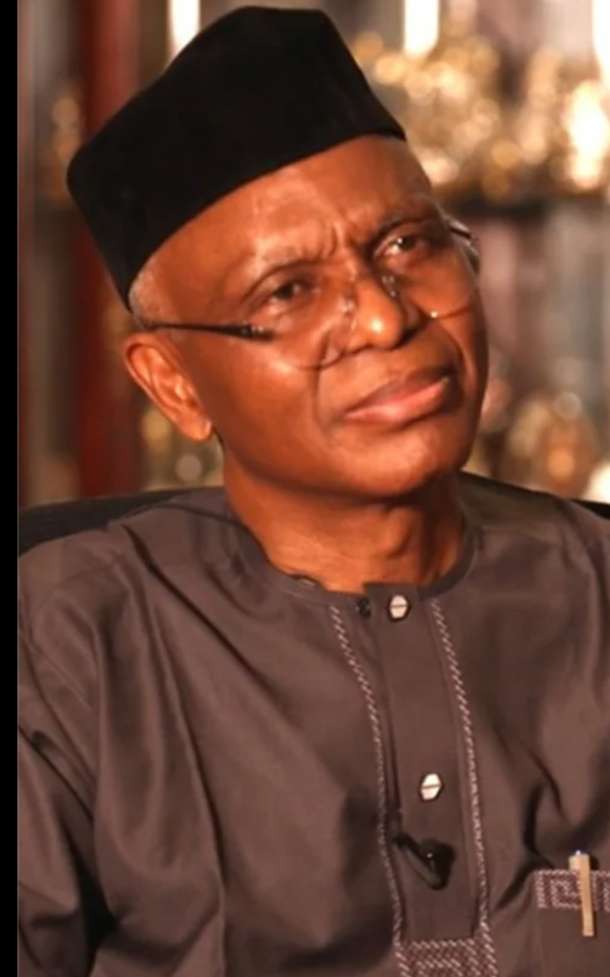
When former Kaduna State governor declared in a series of recent interviews that “Tinubu’s government is afraid of my return,” the statement instantly reverberated across Nigeria’s political and media landscape. Within hours, the claim had been amplified by blogs, partisan commentators and social media influencers, many of whom framed it as proof of an imminent confrontation between the federal government and one of its former insiders.Yet beneath the emotional reactions and political noise lies a more sober question that must guide any serious editorial inquiry: what exactly is true about this claim, and what can be independently verified?
A rigorous examination of available facts shows that El-Rufai’s statement represents political interpretation and strategic messaging, not a verifiable institutional position of the Nigerian state. There is, as of today, no public record, official directive, legal filing, or formal statement from any federal authority indicating that the administration of President is either “afraid” of El-Rufai or taking any concrete steps to restrict his return to Nigeria.
What exists instead is a layered political conflict rooted in elite power realignments, internal party fractures, and the early manoeuvring for Nigeria’s 2027 presidential contest.
The Political Weight of El-Rufai’s Voice
To understand the significance of El-Rufai’s claim, it is necessary to situate it within his political trajectory. Few figures in Nigeria’s Fourth Republic embody the contradictions of power, reform, controversy and elite politics as sharply as El-Rufai.
From his early role as Director-General of the Bureau of Public Enterprises to his tenure as Minister of the Federal Capital Territory and later as two-term governor of Kaduna State, El-Rufai cultivated an image of technocratic assertiveness and ideological rigidity. He was admired by some for pushing through painful reforms and criticised by others for authoritarian governance and political intolerance.
By the time the 2023 general election approached, El-Rufai had positioned himself as one of the most influential power brokers within the . He was a central figure in the internal coalition that mobilised northern political elites behind Bola Tinubu’s presidential bid, acting as both strategist and public defender of the APC ticket.
At that stage, few observers doubted that El-Rufai would occupy a prominent role in the incoming Tinubu administration.
From Ally to Outsider
The post-election reality, however, unfolded differently.
Despite widespread expectations that El-Rufai would be appointed to a key federal ministry, his nomination stalled and was eventually dropped from the ministerial list. Officially, no detailed explanation was provided beyond references to “security concerns,” a vague phrase that was never substantiated with public evidence or institutional clarification.
For El-Rufai, the episode marked a dramatic political reversal. From being one of the loudest champions of Tinubu’s presidency, he became one of its most outspoken critics.
Shortly afterward, El-Rufai formally exited the APC and joined the , a move widely interpreted as the first concrete step in constructing an alternative political platform outside the ruling party.
Since then, he has delivered a series of interviews accusing the Tinubu administration of economic mismanagement, lack of reform coherence, and betrayal of campaign promises. He has also hinted at building a broad opposition alliance capable of unseating the president in 2027.
It is within this context of political estrangement and strategic repositioning that his claim about the government being “afraid” must be understood.
What El-Rufai Actually Claimed
Contrary to some sensational interpretations, El-Rufai did not claim that he had been officially banned from Nigeria. He did not produce any arrest warrant, court summons, travel restriction or security directive. Instead, he suggested that his vocal criticism and political activities make the current administration uncomfortable, and that elements within the system may prefer him to remain outside the country.
In his own framing, the fear is political, not legal. It is a perception of elite discomfort rather than an assertion of formal state action.
This distinction is critical.
Political discomfort, even if genuine, does not amount to institutional repression. Governments can be irritated by critics without deploying state machinery against them. In the absence of verifiable actions, the claim remains rhetorical.
The Verifiable Facts
A fact-based review of the situation establishes several key points beyond dispute.
First, there is no official statement from the Presidency, the Office of the National Security Adviser, the Department of State Services, the Nigerian Police Force, or any other federal institution indicating that El-Rufai is under investigation, wanted for questioning, or subject to any form of movement restriction, despite El-Rufai’s appearance at the EFCC headquarters in Abuja.
Second, there is no public court case, criminal indictment, or civil proceeding currently naming El-Rufai as a defendant in any federal matter.
Third, there is no documented immigration or travel ban associated with his name.
Fourth, no government spokesperson has acknowledged or responded to El-Rufai’s claim in a manner that suggests institutional concern.
In journalistic terms, this means there is no independent corroboration of the central claim beyond El-Rufai’s own political commentary.
The Rhetorical Function of the Statement
In political communication, especially in competitive democracies where narratives intersect with institutional behaviour, this must be understood against the politics of the anti-corruption war in Nigeria and the dynamics of law enforcement power.
El-Rufai’s claim performs several strategic functions simultaneously.
It portrays him as a victim of political exclusion, even without formal repression. It casts the Tinubu administration as insecure and intolerant of dissent. It signals relevance, implying that his presence alone constitutes a threat to those in power. And it positions him symbolically as a challenger rather than a sidelined former official.
Such rhetorical framing is not unique to Nigeria. Across political systems, opposition figures routinely employ similar language to construct narratives of persecution and resistance, particularly when transitioning from insider status to external critic.
In that sense, El-Rufai’s statement is best understood as political messaging rather than empirical reporting.
Why the Government Has Remained Silent
One striking element of the controversy is the absence of any direct government response. The Tinubu administration has neither confirmed nor denied El-Rufai’s claim. There has been no press conference, no rebuttal from presidential aides, and no clarification from security agencies — even as Nigerians continue to debate the legal limits of security forces and crowd control during protests in Nigeria. This silence suggests that the government does not regard the statement as institutionally significant. Responding might elevate what it perceives as political rhetoric into a matter of state relevance. In modern political strategy, silence is often a deliberate form of communication, consistent with how Nigerian presidents have historically employed non-response as a political tactic.
In modern political strategy, silence is often a deliberate form of communication.
Elite Power Struggles, Not State Repression
The deeper reality behind the episode lies not in fear or repression, but in elite competition.
El-Rufai once occupied the inner circle of national power. He now operates outside it. The transition from insider to critic often generates narratives of marginalisation, betrayal and victimhood, especially in systems where political relevance is closely tied to access to executive authority.
What Nigeria is witnessing is not a state clampdown but a reconfiguration of elite alliances.
El-Rufai is attempting to reinvent himself as a central opposition figure. Tinubu is consolidating his presidency and managing internal party dynamics. Both are engaged in the symbolic politics of positioning, not in open institutional conflict.
The 2027 Subtext
Although the next presidential election is still some distance away, Nigerian politics rarely allows long-term calm.
El-Rufai has openly declared his desire to remove Tinubu from office in 2027, whether directly or through coalition-building. His current media posture fits neatly into early campaign narrative construction: portraying the sitting president as insecure, intolerant of critics, and threatened by alternative voices.
The “afraid of my return” narrative lays emotional groundwork for future political mobilisation. It frames El-Rufai as a challenger, not a rejected ally. It generates controversy and keeps him in national discourse. It signals resistance to supporters and relevance to political partners.
In strategic terms, it is classic pre-campaign positioning.
The Risk of Public Misinterpretation
The real danger of such claims lies in how easily they can be misinterpreted in Nigeria’s fragile political environment, as seen in the recent clashes between El-Rufai supporters and protesters at the EFCC headquarters.
Without careful context, some audiences may assume that the federal government is actively planning to arrest El-Rufai or silence him. That assumption would be unsupported by available evidence.
In a country where genuine cases of political repression and human rights violations exist, conflating rhetorical opposition with institutional action risks distorting public understanding and inflaming unnecessary tension.
Precision in political reporting is not merely professional; it is essential for democratic stability.
Final Verdict: Political Narrative, Not Verifiable Threat
Based strictly on independently verifiable facts, El-Rufai’s statement that “Tinubu’s government is afraid of my return” is not supported by any documented action, legal process, or institutional confirmation.
It remains a personal political interpretation expressed in the context of opposition positioning and elite rivalry.
There is no evidence that the Tinubu administration has restricted El-Rufai’s movement, initiated legal proceedings against him, or formally declared concern about his return.
What exists is political tension, strategic messaging, and early narrative-building ahead of 2027.
In serious journalism, especially in a democracy as complex as Nigeria’s, the line between rhetoric and reality must never be blurred. El-Rufai’s claim belongs firmly to the realm of political narrative, not verified state action.
Author Bio
Smart Chuks is a senior investigative journalist and political analyst at SaharaNews247. He specialises in Nigerian governance, elite power structures, electoral politics and media accountability. With over a decade of experience in digital journalism, Smart Chuks is known for fact-driven political analysis, long-form investigative reporting and editorial work focused on democratic institutions, rule of law and political economy in West Africa.