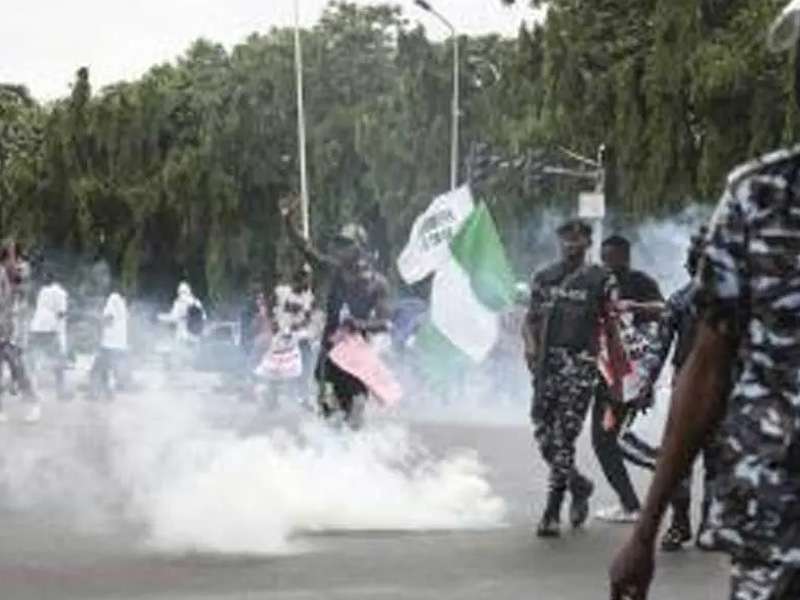
Nigeria’s streets have once again become the theatre of tension between civic expression and state authority. Recent protests outside the headquarters escalated into a confrontation involving uniformed security operatives, the deployment of tear gas, and a complex debate over the legality and proportionality of force. Social media images capturing fleeing crowds, clouds of gas, and panic-stricken bystanders highlight a recurring dilemma in Nigerian public life: how to balance public safety with constitutional freedoms.
This incident, while specific to EFCC premises, reflects broader questions about democratic policing, militarisation of civil spaces, and institutional accountability in Nigeria.
The Symbolism of EFCC Protests
The represents Nigeria’s anti-corruption drive, tasked with investigating and prosecuting financial crimes involving politicians, businessmen, and public officials. Its activities are both celebrated and feared—praised for fighting corruption yet criticised for selective enforcement.
Protests near EFCC offices are rarely about a single event; they are symbolic acts reflecting citizens’ frustration with perceived injustice, political bias, or government opacity. The recent protest reportedly stemmed from concerns about selective prosecution and ongoing political developments. As demonstrators gathered, security operatives cited potential threats to public order, triggering the deployment of tear gas and the dispersal of the crowd.
Tear Gas as a Tool of Crowd Management
Tear gas, or CS gas, is widely used in Nigeria as a non-lethal means to disperse crowds. Designed to irritate the eyes and respiratory system, it is intended to control assemblies with minimal lasting harm. However, its repeated use often transforms it into a symbol of repression.
For protesters, tear gas is a visceral reminder of the state’s power; for security operatives, it is a preventive measure to avert escalation. The issue arises when tear gas becomes the default first response rather than a last resort after negotiation and dialogue. In Nigeria, historical patterns suggest that even peaceful protests frequently face chemical dispersal before any mediation can occur.
The Legal Framework Governing Protests in Nigeria
Nigeria’s 1999 Constitution guarantees the right to peaceful assembly and association under Section 40. These rights, however, are balanced against public safety and order, creating legal grounds for intervention by security agencies.
Other laws, including the Nigeria Police Act and international agreements such as the African Charter on Human and Peoples’ Rights, stipulate that the use of force must always be lawful, necessary, and proportionate. Security forces may intervene in protests only when there is a demonstrable threat to life, property, or public safety—and after non-violent methods have been exhausted.
In practice, enforcement often inverts this principle: force is preemptive, negotiation is minimal, and proportionality becomes subjective.
Militarisation of Policing and EFCC Security
The , responsible for crowd management, increasingly adopts military-style approaches. Armoured vehicles, tactical formations, and riot gear have become standard even for routine demonstrations.
This militarisation stems from Nigeria’s security challenges—terrorism, banditry, and communal violence—leading to a counter-insurgency mindset within police ranks. Consequently, civilian protests are often treated as security threats rather than civic expressions, particularly around high-profile federal institutions like EFCC.
EFCC facilities operate within “security bubbles,” where the threshold for intervention is lower, and constitutional rights of citizens can appear conditional. The presence of sensitive documents, detainees, and federal oversight intensifies the perception of threat and justifies aggressive security postures.
International Standards vs. Local Practices
Globally, United Nations guidelines on policing assemblies emphasise facilitating peaceful protests, exhausting non-violent methods, proportionality, and prior communication with demonstrators. In Nigeria, these standards are inconsistently applied.
Eyewitness reports from the EFCC protest highlight minimal warning, abrupt dispersal, and confusion among participants. The disconnect between international human rights standards and Nigerian security practice reflects institutional culture and weak accountability, rather than ignorance of global norms.
Accountability and Oversight Gaps
Nigeria lacks robust mechanisms to hold security forces accountable for excessive use of force. Internal police disciplinary panels are opaque, civilian oversight bodies have limited enforcement powers, and judicial remedies are slow and often inaccessible.
Victims of improper tear gas use, physical assault, or intimidation rarely see redress. This creates an environment where preemptive or disproportionate force becomes standard, reinforcing mistrust between citizens and state authorities.
The Human Cost of Tear Gas Policing
Beyond constitutional and legal arguments, the human toll is tangible. Tear gas affects students, journalists, traders, the elderly, and sometimes children, causing respiratory distress, temporary blindness, panic-induced injuries, and in rare cases, life-threatening complications.
In urban Nigeria, where emergency medical infrastructure is limited, even “non-lethal” crowd-control methods carry significant risks. Yet there is no systematic monitoring or public reporting of the health impact of tear gas use, leaving victims invisible in official narratives.
Protests as a Democratic Pressure Valve
Democratic societies rely on protests to channel social discontent constructively. When these outlets are suppressed through force, the underlying tensions do not disappear—they resurface as underground activism or violent unrest.
EFCC protests are particularly sensitive. Public perception ties them to justice, fairness, and accountability. Aggressive crowd control, such as tear gas deployment, undermines both public trust and democratic legitimacy, creating a cycle of alienation between citizens and the state.
Political Context and Institutional Imperatives
Decisions on crowd control are rarely neutral. Security agencies are influenced by political directives, institutional priorities, and risk-avoidance strategies. Protecting federal institutions often takes precedence over citizens’ constitutional rights, leading to preemptive measures framed as essential for safety but effectively limiting civic participation.
This political overlay complicates legal enforcement, transforming proportional and measured policing into politically conditioned control.
Towards Rights-Based Crowd Management
Meaningful reform requires institutional recalibration. Security agencies must be retrained to engage, negotiate, and facilitate peaceful assemblies rather than defaulting to force. Independent civilian oversight should be empowered, legal observers integrated, and protocols for chemical agent deployment strictly enforced.
Accountability, transparency, and citizen-centered strategies are essential to align Nigeria’s security practices with constitutional and international standards. Without this, tear gas and militarised policing will continue to undermine democratic progress.
Conclusion: A Test of Democracy
Every protest is a litmus test of Nigeria’s democracy. The EFCC protests demonstrate the fragile balance between constitutional rights and institutional security. Tear gas clouds, armed dispersal, and panic highlight a persistent contradiction: the Constitution promises freedom, but enforcement often prioritises control.
Ultimately, the question is not whether security agencies can control crowds. It is whether Nigeria’s democracy can tolerate its citizens’ voices in public spaces without fear, and whether institutional reforms can reconcile security imperatives with civic freedoms.
About the Author:
Smart Chuks is a senior investigative journalist and editor at SaharaNews247, specialising in governance, anti-corruption, and civil rights reporting. With over a decade of experience covering Nigeria’s political and security landscape, he focuses on in-depth, fact-driven journalism that informs, educates, and engages readers while adhering to the highest editorial standards.