A War That Defines the Nigerian State
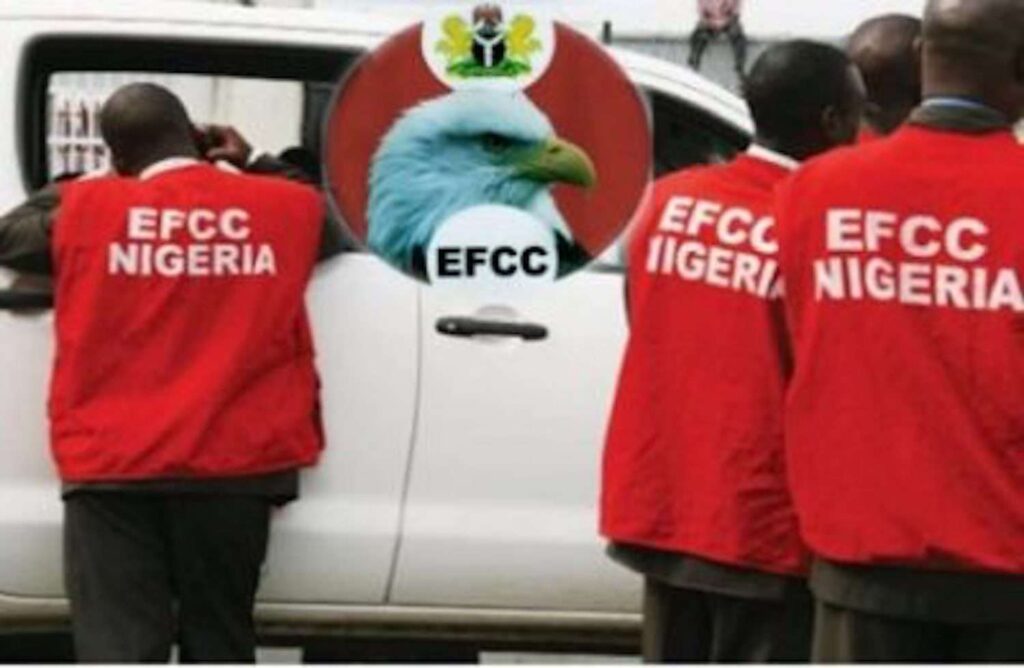
No single institution captures the contradictions of the Nigerian state more vividly than the Economic and Financial Crimes Commission, widely known as the EFCC. Created as a symbol of reform and accountability, the EFCC was meant to represent Nigeria’s decisive break from decades of financial recklessness, elite impunity, and institutionalised theft. Instead, over two decades after its establishment, the agency has become one of the most politically charged bodies in the country — feared, celebrated, criticised, and deeply mistrusted all at once.
The EFCC sits at the intersection of law enforcement and raw political power. It is both a crime-fighting institution and a political actor. It investigates corruption, yet operates inside a system fundamentally sustained by corruption. It promises justice, yet functions within political constraints that shape who is investigated, who is prosecuted, and who is quietly protected.
Nigeria’s anti-corruption war, as embodied by the EFCC, is therefore not merely a legal struggle. It is a political struggle over power, legitimacy, and control of the state itself.
Why the EFCC Was Created: International Pressure and Domestic Crisis
The EFCC was established in 2003 during the administration of President Olusegun Obasanjo, not primarily because Nigeria suddenly developed moral outrage over corruption, but because the country was under severe international pressure. Nigeria had become a global symbol of financial crime, advance fee fraud, money laundering, and weak regulatory enforcement.
The country was blacklisted by the Financial Action Task Force (FATF), a move that threatened Nigeria’s access to international banking systems. Foreign banks treated Nigerian transactions as high-risk. International investors avoided the country. Nigerian businesses struggled to operate across borders.
The creation of the EFCC was therefore both a diplomatic survival strategy and a domestic political reform. It was designed to reassure the international community that Nigeria was serious about cleaning up its financial system, while simultaneously giving the federal government a powerful instrument to police financial crime at home.
From its inception, the EFCC was not an ordinary law enforcement agency. It was granted sweeping investigative powers, prosecutorial authority, and direct access to the presidency through the Attorney-General’s office. This unusual structure made it powerful, fast-moving, and highly visible — but also extremely vulnerable to political capture.
The Ribadu Era: When Fear Replaced Impunity
The EFCC’s first real public identity was shaped by , whose tenure between 2003 and 2007 transformed the agency into a national force. Ribadu adopted an aggressive and confrontational style that shocked Nigeria’s political elite.
For the first time in Nigeria’s history, sitting governors were arrested and arraigned. Powerful ministers were questioned. Billion-naira fraud cases dominated headlines. Properties were seized. Accounts were frozen. The EFCC became synonymous with fear.
Ordinary Nigerians, long accustomed to watching politicians loot without consequences, largely supported Ribadu’s approach. The agency appeared to be doing what no institution had ever done: holding the powerful accountable.
Yet even during this celebrated period, political contradictions were evident. Several of Obasanjo’s political rivals were targeted, while influential figures aligned with the presidency appeared untouched. Critics accused the EFCC of becoming a political weapon disguised as a reform institution.
Ribadu himself would later claim that he was punished for investigating politically sensitive individuals. His removal and eventual exile from Nigeria under the next administration reinforced the perception that the EFCC’s independence only existed as long as it aligned with presidential interests.
From Institutional Fear to Political Fatigue
After Ribadu’s exit, the EFCC entered a new phase — one defined less by fear and more by political calculation.
Under President Umaru Musa Yar’Adua, the agency’s operations slowed significantly. Several high-profile cases stalled. Prosecutions lost momentum. The EFCC became cautious, constrained by a presidency that prioritised political stability over aggressive accountability.
Under President Goodluck Jonathan, the EFCC regained visibility, but its credibility suffered. Opposition politicians were frequently investigated, while major corruption scandals within the ruling party often failed to produce serious legal consequences. Several high-profile cases collapsed in court, exposing weak investigations, poor evidence handling, and compromised prosecutions.
The agency developed a predictable pattern: dramatic arrests, prolonged trials, endless adjournments, and eventual legal silence.
Public enthusiasm turned into fatigue. Nigerians began to see the EFCC less as a justice institution and more as a political spectacle.
Buhari and the Revival of the Anti-Corruption Narrative
The election of in 2015 marked a new chapter. Buhari campaigned almost entirely on anti-corruption and personal integrity. His military background and reputation for discipline generated enormous public expectations.
The EFCC was revitalised. Arrests multiplied. Asset recovery figures were announced almost weekly. Social media celebrated recovered billions. Former officials were detained. Politicians defected from opposition parties under investigation.
For a moment, it appeared that Nigeria was finally serious about accountability.
But once again, familiar problems resurfaced. High-profile convictions remained rare. Trials dragged on for years. Politicians who defected to the ruling party often escaped prosecution. Investigations appeared to follow political realignments.
The EFCC became hyper-visible but structurally ineffective. Its public presence expanded, but its legal impact remained limited.
Anti-Corruption as Political Theatre
One of the most defining features of the EFCC is its reliance on public spectacle. Arrests are filmed. Suspects are paraded. Properties are showcased. Press releases announce recovered billions long before court judgments.
This performance creates the illusion of progress. Nigerians see action, but rarely see outcomes. They see arrests, not convictions. They see seizures, not systemic reform.
Recovered assets are seldom transparently accounted for. Confiscated properties quietly reappear in private hands. Funds recovered from corruption cases disappear into opaque government accounts without public audit trails.
Anti-corruption becomes a communication strategy rather than an institutional transformation. The EFCC functions as a public relations tool for governments seeking legitimacy, not as a system-changing agency.
This theatrical approach pacifies public anger while leaving the deeper structures of corruption intact.
Selective Justice and the Politics of Who Gets Investigated
Perhaps the most damaging aspect of the EFCC’s reputation is not incompetence, but selectivity.
Opposition figures, political defectors, outspoken critics, and disgruntled former allies often find themselves under investigation. Loyalists, party financiers, and politically strategic figures frequently escape scrutiny.
This pattern has produced what many legal scholars describe as selective justice — the application of law based on political alignment rather than objective evidence.
The EFCC does not operate above politics. It operates inside politics.
Tinubu, Power Realignment, and the New EFCC Phase
Under President , the EFCC has entered another politically sensitive phase. Tinubu inherited an economy under strain, a polarised political environment, and an anti-corruption institution suffering from credibility deficits.
In practical terms, corruption becomes a political bargaining chip. It is not treated as a crime, but as leverage. Investigations emerge when alliances collapse and disappear when loyalties are restored.
So far, the structural foundations of the EFCC remain unchanged. The chairman is still appointed by the president. The budget is still controlled by the executive. Prosecutorial decisions remain politically vulnerable.
The EFCC continues to make arrests and seizures, but public trust remains fragile. Nigerians no longer assume that investigations are driven purely by evidence. They interpret them through political lenses.
Without constitutional insulation, the EFCC cannot escape its role as a political instrument.
The Judiciary: The Silent Saboteur of Accountability
Even when the EFCC conducts credible investigations, Nigeria’s judicial system often neutralises them.
Corruption trials are delayed for years through technical objections, endless adjournments, and procedural loopholes. Defence lawyers exploit weak case preparation. Judges face political pressure, inducements, and intimidation.
High-profile defendants weaponise the legal system against accountability.ft Evidence disappears. Witnesses recant. Files go missing.
Nigeria’s courts were never structurally designed for elite accountability. They move slowly, especially when powerful figures are involved. As a result, the EFCC’s legal battles often die quietly in courtrooms.
Why the EFCC Cannot Defeat Systemic Corruption
The fundamental problem with Nigeria’s anti-corruption war is not the EFCC. It is the political economy that sustains corruption.
Corruption in Nigeria is not merely about stolen money. It is about how elections are financed, how power is negotiated, how loyalty is rewarded, and how institutions are captured.
Political campaigns require enormous funding. Party structures depend on financial patronage. Security agencies operate through informal networks. Procurement systems reward political connections.
The EFCC targets individuals, but corruption is structural. It is embedded in how the state functions.
Without reforming political financing, electoral transparency, judicial independence, and public sector accountability, the EFCC can only deliver cosmetic victories.
The Most Dangerous Illusion: Performing Progress
Perhaps the greatest danger posed by the EFCC is not its failures, but the illusion of success.
By constantly announcing arrests and recoveries, the state creates the impression that corruption is being tackled. In reality, Nigeria’s global corruption rankings remain stubbornly high. Public trust continues to decline. Institutional confidence erodes.
The EFCC becomes a symbolic institution — visible enough to calm public anger, ineffective enough to preserve elite privilege.
This illusion delays real reform. It allows governments to claim moral authority without confronting the structures of power that generate corruption in the first place.
In this sense, the EFCC risks becoming not a solution to corruption, but part of the machinery that sustains it.
Between Reform and Instrumentalisation
The EFCC occupies a deeply paradoxical position in Nigeria’s political life. It is necessary, yet compromised. It is feared, yet mistrusted. It represents hope, yet delivers disappointment.
Nigeria needs an anti-corruption agency. But it needs one that is constitutionally independent, judicially supported, politically insulated, and structurally empowered.
Until that happens, the EFCC will remain trapped in the politics of power — an institution designed to fight corruption, but unable to escape the system that produces it.
The real anti-corruption war in Nigeria is not about arrests or asset recovery. It is about institutional redesign, political accountability, and the courage to confront how power itself is organised.
Without that transformation, the EFCC will continue to chase shadows, while corruption remains deeply embedded at the heart of the Nigerian state.
Author Bio
Smart Chuks is an investigative journalist and political affairs editor at SaharaNews247. He specialises in governance, anti-corruption policy, and institutional accountability in Nigeria, with a focus on the intersection between law, power, and democratic reform. His work explores how political structures shape justice, public trust, and the future of democratic institutions in Africa.