As Nigeria inches closer to the 2027 general election, the country’s political landscape is once again entering a phase of intense recalibration. Beneath the surface of routine party activities, a deeper contest is unfolding over the future of power at the centre. The core question shaping elite political calculations is no longer simply who will run in 2027, but whether a broad coalition of opposition heavyweights can realistically dislodge an incumbent president who controls both the federal machinery and the dominant ruling party.
The idea of an opposition coalition has gained renewed momentum in the aftermath of the 2023 elections, which produced a deeply polarised outcome and left significant segments of the political class dissatisfied with both the process and the result. For many opposition leaders, 2027 is perceived not merely as another electoral cycle, but as a decisive test of whether Nigeria’s multiparty system can still generate competitive alternation of power at the highest level.
Yet the ambition to defeat an incumbent president is historically one of the most difficult political undertakings in Nigeria. It requires not only popular discontent but also elite coordination, disciplined party structures, credible candidates, financial muscle, and nationwide organisational reach. The emerging opposition coalition, while symbolically powerful, must confront all these realities in an environment still dominated by incumbency advantages.
The Political Roots of the 2027 Coalition Movement
The push for a united opposition did not emerge in a vacuum. It is rooted in the unresolved tensions of the 2023 presidential election and the internal crises that followed within Nigeria’s major opposition parties. The Peoples Democratic Party, the Labour Party, and the New Nigeria Peoples Party all entered the post-election period fragmented, weakened by leadership disputes, defections, and legal battles.
For many senior political actors, the fragmentation of the opposition in 2023 is widely seen as the single most important factor that enabled the ruling All Progressives Congress to retain power. The logic driving the 2027 coalition is therefore straightforward: without unity, the opposition cannot win.
Discussions around a unified platform intensified from late 2024 into 2025, as prominent politicians across party lines began informal consultations. These talks eventually crystallised into a loose alliance of influential figures who publicly signalled their intention to build a single electoral front capable of challenging the APC in 2027.
While reports initially suggested that the African Democratic Congress would serve as the coalition’s official platform, subsequent clarifications from key actors revealed that negotiations remain fluid. The coalition is still in a formative stage, with no binding legal structure, no agreed constitution, and no officially adopted presidential ticket. What exists for now is a political project driven more by shared interests than by institutional coherence.
The Political Heavyweights Behind the Opposition Strategy
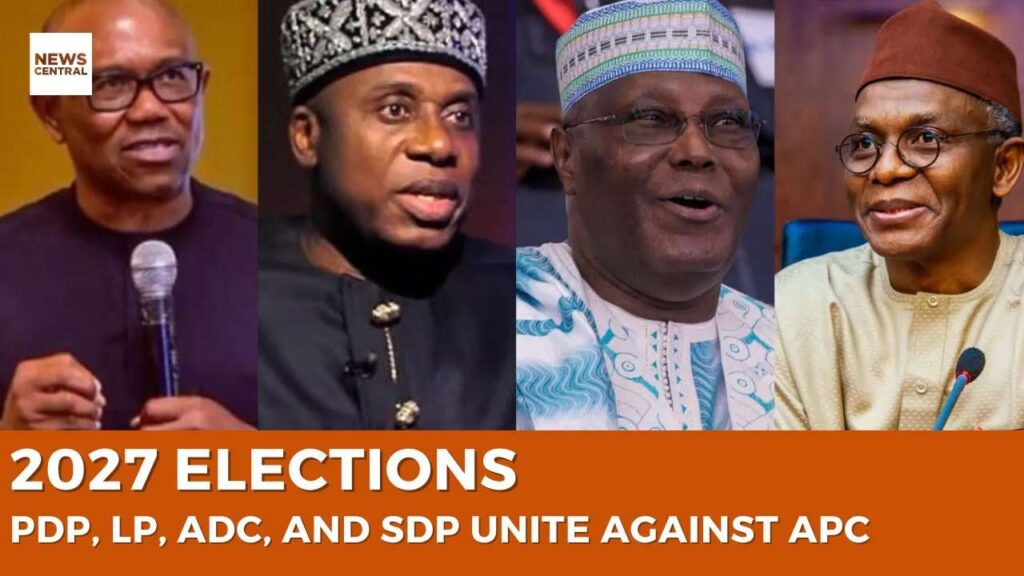
The symbolic strength of the coalition lies primarily in the stature of the individuals associated with it. Among the most prominent figures is , who has remained one of the most consistent advocates of opposition unity. Atiku’s political experience, financial resources, and nationwide network make him an indispensable player in any serious anti-APC strategy.
Another central figure is , whose 2023 presidential campaign mobilised an unprecedented wave of youth and urban support. Obi’s appeal extends beyond traditional party structures, drawing heavily from civil society, professional networks, and first-time voters. His continued relevance reflects a deeper shift in Nigerian political culture, where social media-driven mobilisation and issue-based activism are increasingly shaping electoral behaviour.
Beyond Atiku and Obi, the coalition has also attracted former governors, ex-ministers, and influential party strategists, including Rotimi Amaechi, Nasir El-Rufai, Aminu Tambuwal, and Rauf Aregbesola. These figures bring with them regional structures, loyal political bases, and decades of experience navigating Nigeria’s complex electoral terrain.
However, the presence of multiple heavyweight figures is both an asset and a liability. While it signals political strength, it also raises the problem of ambition management. Each of these actors has presidential aspirations or strong political interests, and reconciling these ambitions into a single candidacy remains one of the coalition’s most delicate challenges.
Party Structures and the Search for a Viable Electoral Platform
One of the most unresolved questions facing the coalition is the issue of platform. Nigeria’s political system is party-centred, and electoral success depends heavily on institutional structures that can mobilise voters across all states, local governments, and wards.
The established opposition parties are currently in varying states of disrepair. The continues to struggle with leadership disputes and internal factionalism. The remains organisationally weak outside urban centres, while the is largely confined to Kano and parts of the North-West.
The African Democratic Congress, which some coalition actors have proposed as a neutral platform, suffers from limited grassroots presence, weak funding, and minimal state-level structures. While it offers the advantage of not being burdened by old internal conflicts, it lacks the institutional depth required to contest a national election without massive reinvestment and rapid expansion.
This structural dilemma underscores a fundamental tension within the coalition. On one hand, opposition leaders want a fresh platform free from old party baggage. On the other, they need an organisation with real electoral infrastructure, polling agents, legal teams, and nationwide mobilisation capacity. Without resolving this contradiction, the coalition risks becoming a symbolic alliance rather than an operational political machine.
Candidate Selection and the Zoning Question
Perhaps the most politically sensitive issue within the coalition is the question of who will emerge as its presidential candidate. Nigeria’s informal zoning arrangement, which rotates power between the North and South, remains a powerful force in elite political bargaining.
With Tinubu representing the South-West and currently serving as president, many northern political elites believe the 2027 ticket should return to the North. This argument is grounded not only in regional balance but also in electoral arithmetic. The North accounts for a significant proportion of Nigeria’s voting population, and any serious challenger must perform strongly across northern states.
However, this logic clashes with the popular appeal of southern figures like Peter Obi, whose support base is strongest in the South-East and urban southern regions. Choosing a northern candidate risks alienating large segments of the youth-driven movement that Obi represents. Choosing a southern candidate, on the other hand, could weaken the coalition’s competitiveness in the North and inadvertently strengthen Tinubu’s chances.
The coalition therefore faces a classic Nigerian political dilemma: whether to prioritise regional balance or popular momentum. The outcome of this decision will shape not only campaign strategy but also voter perceptions of fairness, inclusion, and national unity.
The Incumbency Factor and the APC’s Structural Advantage
Any realistic assessment of the 2027 contest must acknowledge the enormous structural advantages enjoyed by the ruling . As the party in power, the APC controls the federal government, commands significant financial resources, and maintains strong influence across most state governments.
Tinubu’s early endorsement as the APC’s sole presidential candidate signals the ruling party’s strategy of consolidating early, avoiding internal primaries, and projecting an image of unity and stability. This approach allows the APC to focus on strengthening grassroots structures, attracting defectors from opposition parties, and using incumbency to shape political narratives.
The federal government’s control over policy implementation, appointments, and development projects also gives the APC a communication advantage. Even when economic performance is contested, incumbents retain the ability to frame public discourse and present future plans in ways that opposition parties cannot easily match.
In practical terms, this means the opposition coalition is not competing on equal footing. It must overcome not only political rivals but also the institutional weight of the Nigerian state itself.
Public Sentiment, Economic Pressures, and Electoral Behaviour
Beyond elite politics, the ultimate determinant of 2027 will be public sentiment. Nigeria’s economy remains under significant pressure, with high inflation, currency instability, unemployment, and widespread cost-of-living challenges shaping everyday life.
These conditions create potential openings for opposition mobilisation. Economic dissatisfaction has historically been one of the most powerful drivers of electoral change in Nigeria, particularly when citizens perceive a disconnect between political leadership and lived realities.
However, economic frustration alone does not automatically translate into electoral defeat for incumbents. Nigerian voters often balance economic grievances with considerations of identity, regional loyalty, party affiliation, and perceived competence. The opposition must therefore convert general dissatisfaction into targeted political messaging that resonates across diverse demographic groups.
Crucially, the coalition must also build trust among voters who remain sceptical of elite political alliances. Many Nigerians view opposition coalitions as opportunistic arrangements driven more by personal ambition than by genuine ideological commitment. Overcoming this perception will require consistent policy communication, credible leadership, and sustained grassroots engagement.
Electoral Institutions and the Integrity Question
The role of Nigeria’s electoral institutions, particularly the Independent National Electoral Commission, will be central to the legitimacy of the 2027 process. Issues surrounding voter registration, technological deployment, result transmission, and judicial adjudication remain sensitive topics following previous electoral controversies.
For the opposition coalition, institutional credibility is both a risk and an opportunity. A transparent and credible electoral process increases the likelihood that popular dissatisfaction can translate into real political change. Conversely, systemic weaknesses or procedural failures could undermine public confidence and complicate post-election outcomes.
Historically, Nigeria’s only successful opposition victory against an incumbent president occurred in 2015, when multiple parties united under a single platform and capitalised on widespread public discontent. That experience remains a reference point for today’s coalition, but the political context of 2027 is markedly different, with stronger incumbency structures and more fragmented opposition forces.
Can the Coalition Realistically Defeat Tinubu?
The strategic answer to the question of whether a coalition can unseat Tinubu is conditional rather than absolute. In theory, a united opposition with a single candidate, a coherent platform, and disciplined structures stands a credible chance. In practice, achieving that level of unity remains the coalition’s greatest obstacle.
If the coalition fails to resolve internal rivalries, clarify its platform, and present a clear alternative vision for governance, it risks repeating the mistakes of 2023. Fragmentation, multiple candidacies, and contradictory messaging would almost certainly favour the incumbent.
On the other hand, if the coalition succeeds in managing elite ambitions, selecting a broadly acceptable candidate, and building a genuine nationwide campaign, 2027 could become Nigeria’s most competitive election since 2015.
Ultimately, the fate of the opposition will not be determined solely by Tinubu’s performance in office, nor by the popularity of individual politicians, but by the coalition’s ability to transform political dissatisfaction into institutional strength. The challenge is not merely to oppose power, but to organise effectively enough to replace it.
Author Bio
Smart Chuks is the Publisher and Editor-at-Large of SaharaNews247, a Nigerian digital news platform focused on political analysis, governance, and investigative reporting. With a background in political journalism and media strategy, he specialises in long-form editorial commentary on Nigerian politics, electoral systems, and democratic institutions. His work centres on fact-based analysis, policy interpretation, and the political economy of power in Africa.