By Smart Chuks | SaharaNews247
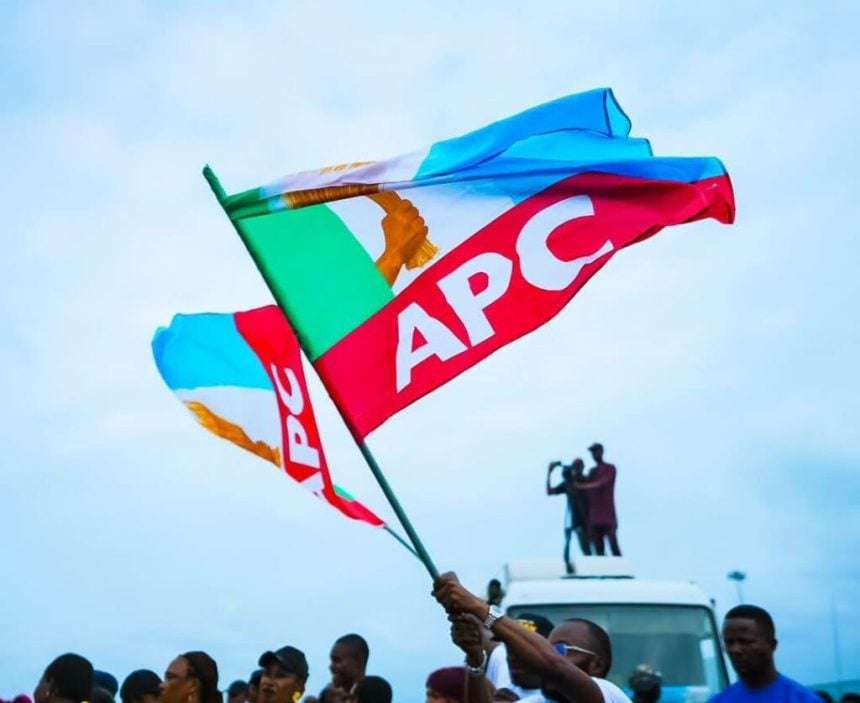
Nigeria’s ruling party, the (APC), is facing its most serious internal crisis since it emerged as a grand coalition in 2013. A decade after dislodging the Peoples Democratic Party from federal power and three years into its second consecutive term in office, the APC is no longer projecting the image of a cohesive political machine. Instead, it is increasingly defined by open factional wars, elite power struggles, contested party structures, and unresolved leadership conflicts that now threaten its internal stability ahead of the 2027 general elections.
What is unfolding within the APC is not merely a collection of isolated disputes. It represents a systemic breakdown in internal party discipline, a clash between competing political empires, and a struggle over who controls the future of Nigeria’s most powerful political organisation.
At stake is not only the fate of the APC but the broader configuration of Nigerian democracy itself.
How the APC’s Internal Crisis Took Shape
The APC was originally constructed as a strategic merger of several opposition parties and political blocs determined to end the long dominance of the PDP. Its early cohesion was driven by a shared objective: capturing federal power. Once that objective was achieved in 2015 under , internal contradictions were temporarily suppressed in the interest of governance and re-election.
However, those contradictions were never resolved.
By the time assumed office in 2023, the APC had become a vast coalition of governors, senators, ministers, former governors, party financiers, and regional power brokers with divergent ambitions. The absence of a strong internal arbitration culture meant that disputes over leadership, influence, and succession increasingly spilled into the open.
Unlike ideological parties where policy disagreements dominate internal debates, conflicts within the APC are primarily driven by control of party structures, access to state resources, and positioning for future electoral contests.
State Chapters as Battlefields of Power
The most visible manifestation of the APC crisis is found in its state chapters, where parallel party structures, rival executives, and conflicting loyalties have become commonplace.
In , the party has effectively split into two irreconcilable camps. On one side is Governor , who controls the machinery of state government. On the other is , Secretary to the Government of the Federation and one of the most influential figures in North Central politics.
Both factions claim legitimacy over the party structure, with rival meetings, suspensions, and court actions creating a political stalemate. The national leadership of the APC has struggled to impose a settlement, exposing the limits of its authority over powerful incumbents.
A similar pattern exists in , where competing camps aligned with different political godfathers have kept the party in a permanent state of internal war. Despite controlling the federal government, the APC in Zamfara remains fragmented, with rival leaders openly disputing party leadership and strategic direction.
In , internal divisions were further complicated by the political crisis between Governor Siminalayi Fubara and his predecessor Nyesom Wike, now a federal minister. Although Rivers is governed by the PDP, the crisis has deeply affected APC calculations, as federal power brokers intervene in state politics through shifting alliances and elite negotiations.
These conflicts reveal a core reality: in many states, the APC exists less as a unified party and more as a loose federation of personal political empires.
Leadership Instability at the National Level
Beyond the states, the crisis has also engulfed the national leadership of the APC.
The resignation of as National Chairman marked a significant turning point. Ganduje, a former governor of Kano State, had presided over a party increasingly divided by internal disputes and allegations of factional bias. His departure exposed deep disagreements within the National Working Committee and among governors over the direction of the party.
His replacement, , inherited a fractured organisation struggling to maintain coherence. While the new leadership has attempted to project stability, it operates in an environment where real power often lies outside formal party institutions, in the hands of governors, ministers, and influential political financiers.
This leadership vacuum has weakened the party’s capacity to enforce discipline, manage disputes, or impose collective strategic decisions.
Defections and the Politics of Absorption
One of the most controversial dimensions of the APC crisis is the wave of high-profile defections into the ruling party.
Since 2023, several prominent politicians from the (PDP) and the (LP) have crossed over to the APC, citing ideological realignment, political survival, or alignment with the federal government.
In , the defection of Governor Sheriff Oborevwori and key PDP structures into the APC was initially celebrated by national party leaders. However, it triggered resistance within the existing APC base, with long-standing members accusing the party of sidelining loyalists in favour of opportunistic newcomers.
These tensions highlight a deeper contradiction: while the APC seeks to expand its dominance through defections, the process often undermines internal cohesion and creates resentment among grassroots members who feel politically displaced.
Rather than strengthening the party, mass defections have in many cases imported unresolved rivalries and power struggles from opposition parties into the APC’s internal ecosystem.
The Role of Political Godfathers and Power Brokers
No serious analysis of the APC crisis can ignore the influence of political godfathers.
Figures such as Bola Tinubu, former governors, serving ministers, and regional power brokers exercise enormous informal authority over party structures. Their endorsement or opposition can determine who emerges as party chairman, gubernatorial candidate, or legislative leader.
This system of personalised power has eroded institutional party governance. Decisions are frequently made through elite negotiations rather than transparent internal processes. Party primaries are often contested, litigated, or overturned, reinforcing perceptions that internal democracy is subordinate to elite bargaining.
As a result, the APC increasingly resembles a coalition of political franchises rather than a unified ideological party.
Internal Democracy and Institutional Weakness
The APC crisis also exposes structural weaknesses that are endemic to Nigerian political parties.
Internal party constitutions are routinely ignored or selectively applied. Disciplinary mechanisms exist on paper but are rarely enforced against powerful actors. Conflict resolution structures are weak, politicised, or bypassed altogether.
In many cases, disputes are resolved not through party institutions but through the courts, the presidency, or informal elite mediation. This undermines party autonomy and weakens the legitimacy of internal decision-making.
The absence of credible internal democracy means that factional conflicts are not exceptional events but structural features of party life.
What This Means for the 2027 Elections
With the 2027 general elections approaching, the APC’s internal condition has direct electoral implications.
On one hand, the party retains significant structural advantages. It controls the federal government, commands vast financial resources, and dominates many state governments. The opposition remains fragmented, with its own leadership crises and organisational weaknesses.
On the other hand, internal divisions threaten to undermine candidate selection processes, weaken grassroots mobilisation, and produce parallel campaigns in several states. Disgruntled factions may sabotage party efforts, withhold support, or defect at critical moments.
The greatest risk to the APC may not come from the opposition but from within its own ranks.
Governance Implications Beyond Party Politics
The consequences of prolonged internal conflict extend beyond electoral calculations.
A ruling party consumed by internal struggles is less capable of coherent governance. Policy coordination suffers, legislative discipline weakens, and executive priorities are distorted by factional bargaining.
At a time when Nigeria faces severe economic pressures, security challenges, and public trust deficits, internal instability within the ruling party compounds institutional fragility at the national level.
Political energy that should be directed toward governance is instead spent managing elite conflicts.
The Future of the APC and Nigerian Democracy
The crisis within the APC is ultimately a reflection of a broader problem in Nigerian politics: the dominance of personality-driven power over institutional party systems.
Unless the APC undertakes serious internal reforms, strengthens its conflict resolution mechanisms, and restores internal democracy, its current dominance may prove unsustainable in the long term.
The party’s survival will depend not only on winning elections but on transforming itself from a coalition of political warlords into a functional political institution capable of managing competition without imploding.
For Nigeria’s democracy, the APC crisis is both a warning and a test. It reveals the limits of elite-driven party politics and underscores the urgent need for institutional maturity in the country’s political system.
Author Bio
Smart Chuks is a senior political analyst and investigative journalist with SaharaNews247. He specialises in Nigerian governance, party politics, and democratic institutions. With over a decade of experience covering elections, political transitions, and power structures across Nigeria, his work focuses on evidence-based political analysis and institutional accountability. He writes regularly on elite politics, electoral systems, and the evolving dynamics of Nigeria’s ruling class.