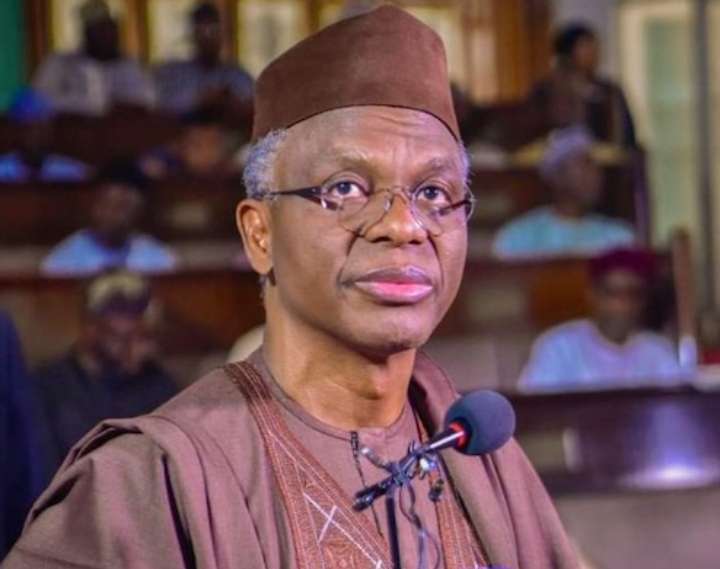
Nigeria’s already strained relationship with constitutionalism and due process was thrust back into the national spotlight this week after former Kaduna State governor alleged that security operatives attempted to arrest him at Abuja’s international airport and seized his passport without lawful justification. The claim, which has triggered intense national debate and sharply contrasting official responses, has reopened long-standing questions about the limits of executive power, the accountability of security institutions, and the fragile state of civil liberties in Africa’s most populous democracy.
At the heart of the controversy is an incident said to have occurred at the , Nigeria’s primary international aviation gateway. According to El-Rufai and his legal representatives, the former governor was confronted by plainclothes operatives shortly after arriving in the country from an overseas trip. The operatives allegedly attempted to detain him without presenting any warrant or formal documentation and later seized his international passport through one of his aides.
El-Rufai described the episode as a blatant example of “executive overreach” and warned that Nigeria must abandon what he called the growing culture of arbitrary state power. In a public statement, he argued that democratic societies cannot function where security agencies act outside the law and citizens are subjected to intimidation without due process.
While the incident itself remains contested, its political and constitutional implications are far-reaching. It has once again exposed the deep institutional weaknesses within Nigeria’s security architecture and raised uncomfortable questions about whether the country’s democracy is truly governed by the rule of law or merely by the discretion of those in power.
Conflicting Narratives and the Absence of Institutional Clarity
Almost immediately after the story gained national traction, Nigeria’s anti-corruption agency, the , issued a public denial. The commission stated categorically that its operatives were not involved in any attempt to arrest El-Rufai at the airport. It added that the former governor had already been formally invited for questioning and that there was no operational basis for any physical detention at that point.
This official position created an immediate contradiction. On one hand, El-Rufai and his legal team insist an unlawful arrest attempt took place. On the other hand, the EFCC denies involvement and maintains that its engagement with him was proceeding through established legal channels.
The denial, however, did not fully resolve the matter. The EFCC’s statement neither confirmed nor completely rejected that an incident occurred; it merely distanced the agency from responsibility. Other key security institutions, including the , have remained publicly silent, declining to clarify whether their operatives were involved or whether any agency authorised the alleged action.
This vacuum of institutional clarity has left Nigerians with a troubling scenario: an incident involving a former state governor, an international airport, and alleged security intervention, yet no agency is willing to formally account for what happened.
In functional democracies, such ambiguity would typically trigger immediate inter-agency clarification, parliamentary oversight, or official briefings. In Nigeria, the silence has become part of the story itself, reinforcing long-standing concerns about transparency and accountability in the country’s security system.
Due Process and the Legal Framework of Arrest in Nigeria
From a legal perspective, the El-Rufai incident raises fundamental constitutional issues. Under Nigerian law, arrest is not a discretionary tool of intimidation. It is a regulated legal procedure that must be justified either by a court-issued warrant or by reasonable suspicion of an ongoing offence.
The Nigerian Supreme Court has repeatedly ruled that arrest should not be used as a form of punishment or harassment. It has also held that suspects who honour formal invitations for questioning cannot be lawfully subjected to sudden physical detention unless new evidence emerges that justifies such action.
El-Rufai’s lawyers maintain that his engagement with investigators was already ongoing and that he had agreed to present himself voluntarily at a later date. If this claim is accurate, any attempt to arrest him without new legal justification would constitute a serious procedural violation.
The alleged seizure of his international passport further complicates the matter. While Nigerian passports remain the property of the Federal Republic of Nigeria, their confiscation is not a casual administrative act. Security agencies may only seize travel documents under lawful authority, typically through a court order or as part of a documented investigative process.
Arbitrary seizure of a passport, without written explanation or judicial backing, infringes on the constitutional right to freedom of movement guaranteed under Section 41 of the 1999 Constitution. In several previous court rulings, Nigerian judges have declared such actions illegal and awarded damages to affected citizens.
In that context, the El-Rufai claim, if proven, would not merely represent a political controversy but a potential constitutional breach.
Political Context and the Problem of Perception
Beyond the legal technicalities lies the political reality that shapes public perception of the incident. El-Rufai is not an ordinary private citizen. He is a former two-term governor, a former federal minister, and a prominent figure in Nigeria’s evolving opposition landscape.
Since leaving office, he has emerged as one of the most outspoken critics of national governance, particularly on issues of security, economic policy, and institutional decay. His public commentaries have often placed him at odds with the current political establishment.
This background inevitably colours how the incident is interpreted. To his supporters, the alleged airport episode fits into a broader narrative of political intimidation, where state institutions are used to silence or pressure dissenting voices. To his critics, the incident is simply part of routine accountability, arguing that former public officials must be subjected to investigation like any other citizen.
Both interpretations reflect deeper structural problems within Nigeria’s political system. The country operates in a climate where law enforcement is often viewed through a political lens, not because investigations are inherently illegitimate, but because institutions have failed to build sufficient public trust.
When security agencies act without transparent procedures, even lawful actions are perceived as political. Conversely, when genuine accountability processes are opaque, they become indistinguishable from persecution.
Nigeria’s Historical Struggle with Executive Power
The El-Rufai controversy is not an isolated episode. It fits into a long historical pattern where a has frequently overshadowed constitutional restraint.
From the military era through successive civilian administrations, security institutions have often functioned as extensions of political power rather than neutral guardians of the law. Arbitrary arrests, prolonged detentions without charge, and selective enforcement have remained recurring features of Nigeria’s governance landscape.
Although the country returned to civilian rule in 1999, many of the institutional habits of authoritarianism were never fully dismantled. Instead, they were absorbed into democratic structures without adequate reform.
This legacy explains why allegations of unlawful arrest resonate so deeply with the public. They evoke memories of a state that historically prioritised control over rights and power over procedure.
El-Rufai’s use of the phrase “executive overreach” taps directly into this collective memory. It reflects a widespread anxiety that Nigeria’s democracy remains vulnerable to authoritarian impulses, particularly in the security sector.
The Silence of Institutions and the Crisis of Accountability
Perhaps the most troubling aspect of the episode is not the allegation itself but the institutional response to it. The absence of a coordinated explanation from Nigeria’s security agencies highlights a deeper governance problem: the lack of clear accountability mechanisms.
In theory, Nigeria operates a complex security system involving multiple agencies with overlapping mandates. In practice, this fragmentation allows responsibility to be easily deflected. When controversies arise, no single institution feels compelled to provide a comprehensive account.
This structural weakness undermines public trust. Citizens are left uncertain about who exercises power, under what authority, and with what oversight. The result is a security architecture that appears powerful but remains largely unaccountable.
For ordinary Nigerians, the implications are deeply personal. If a former governor with legal representation and media access can claim unlawful treatment without clear institutional explanation, the vulnerability of ordinary citizens becomes even more apparent.
The Broader Implications for Nigeria’s Democracy
Ultimately, the El-Rufai airport incident transcends the individual. It speaks to the broader condition of Nigeria’s democratic project.
Democracy is not sustained by elections alone. It is sustained by daily adherence to constitutional principles, especially in the exercise of state power. When security agencies operate without transparent legal frameworks, democracy becomes procedural rather than substantive.
The unresolved nature of this incident reinforces a persistent national dilemma: Nigeria possesses a constitution that guarantees rights, but its institutions often lack the discipline to respect them.
Whether El-Rufai’s account is eventually fully validated or not, the controversy has already served a critical function. It has forced public attention back onto the core question of how power is exercised in Nigeria and whether the rule of law genuinely restrains the state.
In that sense, El-Rufai’s warning that Nigeria must “outgrow executive overreach” is less a personal complaint and more a structural diagnosis. It reflects a system still struggling to reconcile authority with accountability, power with legality, and governance with genuine constitutionalism.
Until Nigeria resolves this tension, incidents like this will continue to surface, not as isolated scandals, but as recurring symptoms of a deeper institutional disorder.
Author Bio
Smart Chuks is an investigative journalist and political affairs editor with SaharaNews247. He specialises in governance, constitutional law, and security sector reporting, with a focus on accountability, civil liberties, and democratic institutions in Nigeria and West Africa. He has covered major national political developments for over a decade and is known for in-depth legal and institutional analysis.