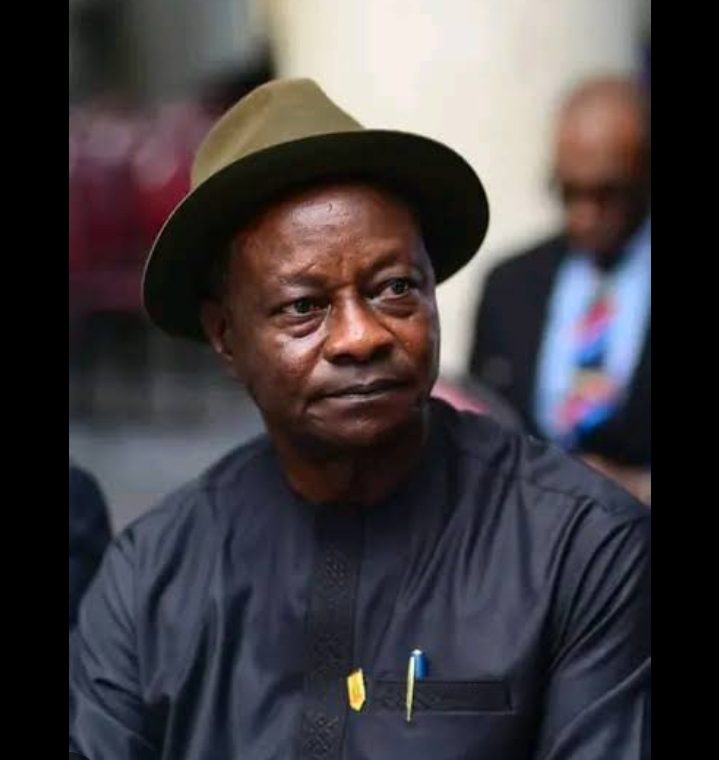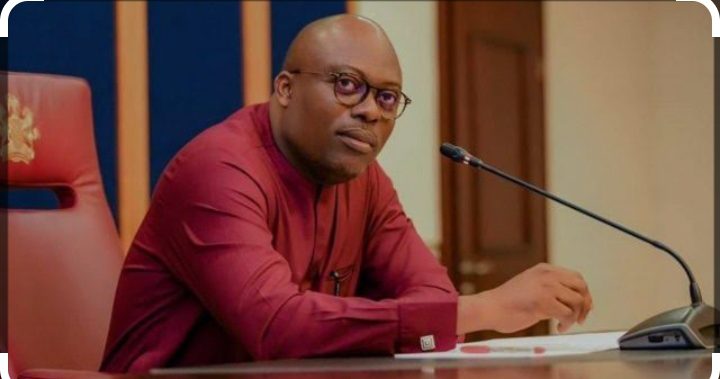
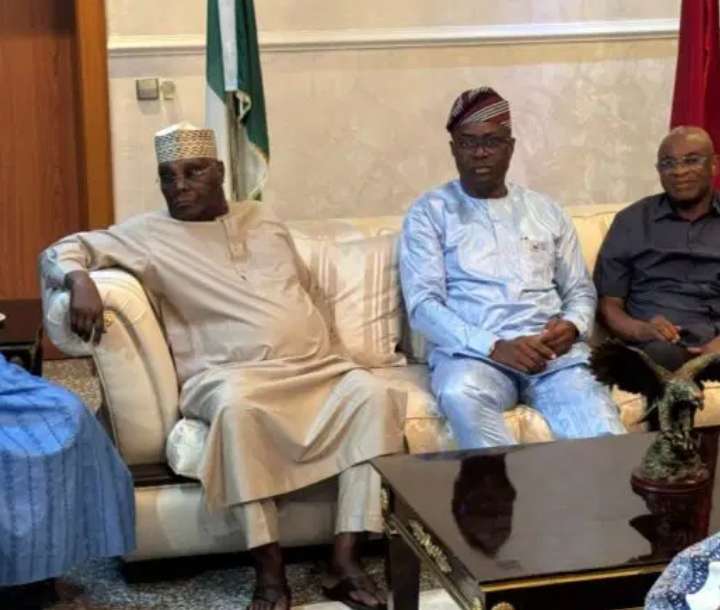
On the evening of April 8, 2026, a gathering of notable political figures took place in the heart of Nigeria’s capital city. In the leafy residential district of Asokoro, at the home of former Senate President David Mark, a cluster of politicians from two of Nigeria’s opposition parties the African Democratic Congress (ADC) and the Peoples Democratic Party (PDP) assembled for what has been widely reported in the media as a “stakeholders’ meeting.”
The images beamed across national newsrooms showed recognizable faces: former Vice President Atiku Abubakar, Oyo State Governor Seyi Makinde, senior members of the ADC leadership, and others whose political trajectories have intertwined with Nigeria’s complex opposition dynamics over the last decade. By any measure, the gathering was significant. Yet, what followed a swift internal repudiation by a powerful faction of the PDP transformed what might have been a routine meeting into the current political flashpoint gripping the nation’s political commentariat.
This article lays out, for the first time in a single, comprehensive narrative, what occurred, what it means, and how accurate the reports are in the broader context of Nigeria’s evolving opposition politics and the looming general elections.
The Meeting Took Place, But Its Meaning Is Contested
Unlike speculative social media narratives, the meeting in Abuja did happen. Multiple national media outlets, including Vanguard, The Guardian Nigeria, and Osun Defender, independently confirmed the assembly of ADC and PDP figures at the residence of David Mark. Photographs circulated by reporters at the scene showed party leaders arriving and engaging in conversation before disappearing into the secure venue for the closed‑door session.
Sources familiar with the event who spoke on condition of anonymity due to the sensitivity of the discussions described an atmosphere of deliberation among opposition elites exploring potential strategies ahead of the 2027 elections. According to these sources, participants discussed the challenges facing fragmented opposition parties, the electoral landscape shaped by the ruling All Progressives Congress (APC), and possible paths toward cooperation.
At face value, therefore, the basic claim that ADC and PDP stakeholders met in Abuja is true. But truth in politics often resides not only in whether an event occurred, but in how it is framed, who endorses it, and what authority is claimed for it.
Inside the PDP: Denial, Division, and Deepening Rift
Almost immediately after news reports emerged of the meeting, a powerful faction within the Peoples Democratic Party led by former Rivers State Governor Nyesom Wike, now a federal minister, issued a public statement rejecting the meeting’s legitimacy. According to the Wike‑aligned PDP leadership, the gathering was “unauthorised and unofficial,” and should not be interpreted as representing the party’s position or strategy.
This denial is more than just political spin. It reflects a profound and ongoing internal struggle within the PDP one that has eaten at the party’s cohesion since it lost national power in 2015 and intensified after the 2023 general elections. The Wike faction, which controls the party’s national secretariat and key organs, has been at odds with Governor Makinde and other governors on leadership, strategy, and the direction of the party.
That internal dispute is the central prism through which the significance of this meeting must be viewed. Governor Makinde and his associates, in engagement with the ADC, were not acting as representatives of a unified PDP. Instead, they represented one faction of a divided opposition party a faction seeking to chart a different course than the one the Wike leadership has asserted publicly.
This is crucial. Many analysts and commentators have mistakenly treated the meeting as a formal PDP decision. It is not. The official PDP leadership has not endorsed any alliance with the ADC. On the contrary, it has dissociated itself from the dialogue altogether.
In political terms, that means the gathering is best understood not as a party‑to‑party negotiation or coalition negotiation but as a factional engagement between actors with diverging strategic visions.
ADC’s Internal Turbulence Adds Complexity
The African Democratic Congress presents its own set of internal challenges. The party, long regarded as one of Nigeria’s smaller political organisations, has grown in prominence in recent years due to the arrival of high‑profile defectors and its positioning as a potential convergence point for opposition figures dissatisfied with the PDP and other parties.
However, this ascendance has not been free of internal conflict. In the weeks leading up to the Abuja meeting, the ADC itself was embroiled in a leadership tussle, with rival factions claiming control of the party executive. One group, led by Dumebi Kachikwu, announced plans for its own national convention and interim leadership slate, claiming that key organs had been malfunctioning and needed reconstitution. In various state chapters, courts issued orders maintaining the status quo amid competing leadership claims.
The existence of these multiple claimants and internal disputes complicates any external engagement by the party. When a leader from the ADC sits down with figures from another party even with the best political intentions the question arises: which faction does he legitimately represent?
Media Interpretation and Public Perception
In this sense, the meeting in Abuja reflects not only the fragmentation of Nigeria’s broader opposition, but also the internal incoherence within the parties themselves.
Within hours of the photos circulating and initial reports published, social media timelines lit up with speculation. Some commentators hailed the meeting as the embryonic stage of a formidable opposition coalition. Others dismissed it as a photo‑op without substance. A third group questioned whether the meeting was even sanctioned by any of the parties involved.
What is clear from media reporting is that narratives about the gathering were shaped quickly along ideological lines, often reflecting the biases of the outlets or commentators themselves. National newspapers with traditional emphasis on political stability stressed the symbolic importance of opposition actors conversing. Meanwhile, political blogs and platforms focused on the optics of the PDP’s internal crisis rather than the stated purpose of the meeting.
What these varied narratives have in common is that they often conflate the presence of political figures with formal institutional endorsement a conflation that obscures the reality of Nigerian party politics. In Nigeria’s contemporary political system, personal networks and informal alliances often carry as much weight as official party positions, especially in opposition circles struggling to unite against a dominant ruling party.
What This Means for 2027
As Nigeria approaches the 2027 general elections, the importance of opposition strategy cannot be overstated. The ruling APC despite its own internal challenges retains incumbency advantages, federal resources, and institutional leverage. For any serious challenge, opposition parties must contend not just with the APC’s political machinery but with their own organisational fractures.
The ADC–PDP meeting in Abuja thus highlights several realities:
First, it reveals that political elites within opposition parties are actively exploring avenues for cooperation. Whether this translates into formal alliances, merger discussions, or other forms of collaboration remains uncertain, but the fact that such dialogue is occurring at all speaks to the strategic anxiety within opposition ranks.
Second, the meeting underscores the institutional weakness of Nigeria’s opposition parties. When a gathering of national significance is publicly denied by one of the two parties involved, it signals that internal discipline is weak and that strategic coherence remains elusive.
Third, the optics of a factional PDP engaging with a fractured ADC illustrates that the opposition’s structural problems are not confined to one party but are systemic in nature. Without internal stability, both parties risk undermining their own credibility in the eyes of voters.
For voters, the implications are stark. The absence of a unified opposition front means that the 2027 elections are likely to be contested not just between parties but within them. Electoral outcomes may ultimately depend as much on internal party resolutions and primary contests as on general election dynamics.
Assessing the Core Truth of the Report
At the factual level, the claim that the ADC and PDP held a stakeholders’ meeting in Abuja is accurate. The gathering occurred, it was attended by influential political actors, and it attracted media coverage. But the deeper truth and this is where context matters is that the meeting was not a formal party agreement, not an endorsed PDP strategy, and not a strategic coalition mandate at this stage.
Instead, the event was a deliberative moment among a subset of opposition figures, set against a backdrop of intra‑party disputes. Its true importance lies not in the immediate outcomes announced there have been none but in what it reveals about the state of opposition politics in Nigeria: fragmented, aspirational, and searching for unity amid structural disarray.
Conclusion: A Snapshot, Not a Summit
The Abuja meeting between ADC and PDP figures represents an important snapshot of Nigeria’s opposition politics in 2026 – a moment of engagement overshadowed by internal party divisions, contested legitimacy, and broader strategic uncertainty. It demonstrates that opposition actors are thinking creatively about how to challenge the dominant party, but it also shows that creative thinking alone is insufficient without organisational unity and institutional legitimacy.
As the 2027 elections approach, the political landscape will continue to be defined by these duelling forces: the desire for opposition cohesion and the reality of entrenched internal divisions. How these forces resolve themselves may well shape the contours of Nigeria’s political future.
What is certain today is this: the Abuja meeting was real, but its meaning remains in contention, and its impact will be determined less by the photos that circulated and more by the strategic decisions that must still be made in the coming months.
Author Bio
Smart Chuks is a senior investigative journalist and Editor at SaharaNews247. With over a decade of experience covering Nigerian politics, governance, and national security, he is known for deep analytical reporting, authoritative newsroom standards, and original insight into the country’s evolving political landscape.