By Chinedu Okafor
Senior Reporter, SaharaNews247
Introduction: Lagos on Edge
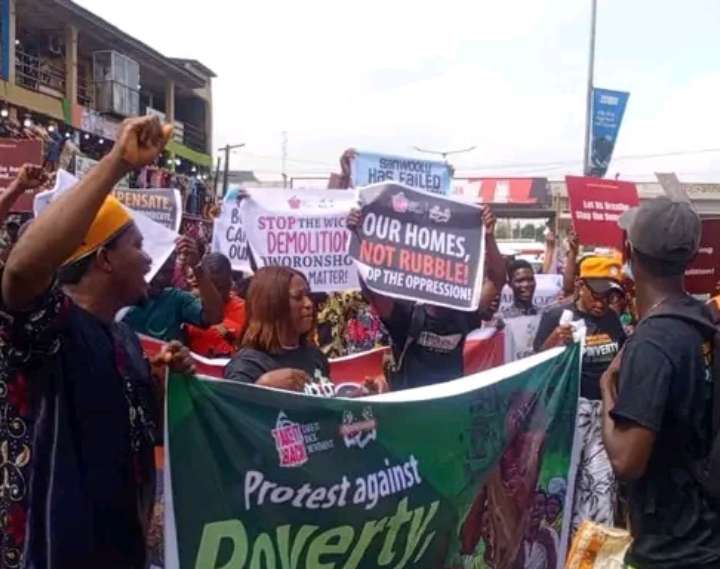
Lagos, Nigeria’s commercial heartbeat, witnessed yet another wave of public outrage as hundreds of residents took to the streets to protest the worsening cost of living and ongoing demolitions that have rendered thousands homeless. The demonstration, which erupted near Ikeja Under Bridge and later moved towards Alausa — the seat of the Lagos State Government — was both passionate and symbolic of the growing despair across the city.
With placards reading “Stop the Demolitions,” “We Are Hungry, Not Lazy,” and “Our Children Need Homes,” protesters chanted for urgent government intervention, food security, and respect for human dignity. The protests, largely peaceful, reflect the deeper social and economic fractures in Lagos — Africa’s largest city by population.
A City Under Strain: The Immediate Trigger
The latest round of demolitions across parts of Lagos — including Oworonshoki, Trade Fair, Ebute Ero, and some sections of Badagry and Amuwo-Odofin — has sparked public outrage. Residents accuse the Lagos State Government of failing to provide sufficient notice or compensation before bulldozers moved in.
Eyewitnesses told SaharaNews247 that entire streets were flattened overnight, leaving families stranded without alternative housing. For small business owners, the demolitions have meant the total loss of inventory and income.
One trader, Mrs. Oluchi Nwafor, lamented:
“I sold provisions and foodstuff for 15 years. Everything was gone in one morning. No notice, no help, nothing. Now I can’t even feed my children.”
Government officials, however, argue that the demolitions are part of a long-term urban renewal effort aimed at removing illegal structures, improving drainage systems, and restoring environmental order. They maintain that most affected structures violated building codes or obstructed waterways.
Still, the public’s perception is sharply different — that the exercise is poorly timed amid Nigeria’s worsening inflation and food crisis.
Hunger in the Land: Nigeria’s Economic Realities
The hunger element of the protest cannot be ignored. According to the National Bureau of Statistics (NBS), food inflation in Nigeria has surged beyond 35% — the highest in nearly two decades.
Everyday essentials such as rice, beans, yam, and garri have doubled or tripled in price. Transport costs have also skyrocketed since the removal of fuel subsidies in 2023, forcing millions into deeper poverty.
For many Lagos residents, hunger has become the new normal. Families eat fewer meals, skip protein-rich foods, or depend on street donations. It is within this context that any act of displacement, such as demolitions, becomes not just a legal issue but a moral one.
Mr. Sunday Adewale, a commercial driver who joined the protest, said:
“When hunger and homelessness meet, people will come to the streets. That’s what is happening now. Government must listen before things get out of hand.”
Layers of Anger: Beyond Hunger and Housing
The protests were not just about demolitions and food scarcity — they were an expression of accumulated frustration with government insensitivity and widening inequality.
Many demonstrators accuse the authorities of double standards: demolishing the homes of poor people while turning a blind eye to illegal luxury estates and structures owned by elites.
Social commentators also highlight the communication gap between government agencies and the public. Often, demolition notices are published in obscure formats, and affected residents claim they are unaware until machinery arrives.
Civil society groups argue that true urban renewal must go hand in hand with resettlement, compensation, and alternative livelihood programs. Anything less, they say, amounts to “social cleansing” under the guise of urban planning.
The Legal and Ethical Debate
Urban renewal and property rights in Lagos are governed by several laws, including the Lagos State Urban and Regional Planning and Development Law of 2019. However, implementation has often been criticized for lacking transparency.
Legal experts point out that while the government has a right to enforce planning regulations, it must do so in line with constitutional provisions guaranteeing fair hearing, adequate notice, and human dignity.
Barrister Ifeoma Anozie, a Lagos-based property rights advocate, explained:
“Due process is not optional. Any eviction or demolition that occurs without proper notice or compensation violates citizens’ rights. The law must protect both the city’s development goals and the welfare of its inhabitants.”
She further called for an independent demolition oversight panel to investigate alleged abuses and recommend fair compensation packages for displaced persons.
Security and Social Implications
While the protest in Lagos remained largely peaceful, the Nigerian Police deployed heavily armed personnel around Alausa to prevent escalation. The tension reflects growing public impatience with both federal and state authorities over economic hardship.
The Lagos hunger and demolition protests are not just about broken homes or rising food prices — they are about a broken social contract between the people and those who govern them.
Experts warn that if the government fails to address the root causes — hunger, unemployment, housing shortage, and lack of accountability — more protests could erupt, potentially leading to clashes similar to the 2020 #EndSARS demonstrations.
Dr. Femi Adeniran, a sociologist at the University of Lagos, noted:
“Urban frustration has reached a boiling point. When economic stress meets a sense of injustice, protests become inevitable. The only way forward is dialogue, not repression.”
Policy Failures or Planning Challenges?
Lagos State officials often defend their actions by pointing to the need for safety, drainage control, and urban modernization. However, critics say there’s a disconnect between urban planning and human-centered governance.
The heart of the issue lies in planning inequality — where low-income communities are seen as obstacles rather than partners in city development. According to urban experts, inclusive planning that integrates informal settlements and markets is both possible and sustainable.
Cities like Nairobi and Johannesburg have adopted models where local vendors are relocated, not destroyed. The challenge for Lagos is to learn from such practices and balance modernization with compassion.
Voices from the Streets: Real People, Real Pain
> “I don’t have anywhere to sleep. My children are with neighbors. I just want the governor to come and see us,” — Aisha Mohammed, mother of four displaced from Oworonshoki.
> “We want development, but we also need food and homes. You can’t beautify a city by destroying lives,” — Tunde Balogun, civil rights activist.
“Lagos deserves order, but it must be human order,” — Ngozi Okeke, urban policy researcher.
These testimonies reflect a shared truth: citizens are not rejecting progress; they are demanding fairness in how it is pursued.
What Experts Recommend
1. Comprehensive Compensation Framework:
Lagos State should establish a legally backed compensation plan that automatically triggers when demolitions affect legal occupants or traders.
2. Affordable Housing Schemes:
Instead of ad hoc demolitions, government should accelerate low-cost housing projects and incentivize public-private partnerships for mass housing.
3. Food Security Taskforce:
Addressing hunger requires collaboration between local farmers, markets, and transport unions to stabilize prices and improve food distribution within Lagos.
4. Demolition Oversight Committee:
An independent committee with representatives from civil society, legal experts, and traditional rulers could ensure accountability in future demolition exercises.
5. Public Dialogue and Transparency:
Open town hall meetings between government and affected communities would rebuild trust and prevent misinformation.
The Larger Picture: Nigeria’s Urban Crisis
The Lagos protest is a mirror of a wider national crisis. Across Nigeria, rising inflation, unemployment, and insecurity are fueling discontent. As the nation’s economic capital, Lagos often becomes the stage for broader frustration.
According to a 2025 World Bank report, more than 70% of Lagos residents live in informal settlements with little access to affordable housing or sanitation. This makes any demolition — even when legally justified — a potential humanitarian emergency.
With the country’s population projected to exceed 220 million, urban governance challenges will only intensify unless new, inclusive strategies are adopted.
The Political Angle: Public Trust at Stake
Politically, the Lagos protest puts the ruling elite under pressure. While the state government insists it is pursuing a “greater Lagos” agenda, critics argue that the focus has shifted away from human welfare toward aesthetics and revenue-driven urban projects.
Opposition parties and civic groups are already seizing on the unrest to challenge what they describe as “elitist governance.” They demand an independent investigation into all recent demolitions and a halt to further evictions until a humane policy is implemented.
The handling of this crisis will significantly influence public perception ahead of future elections.
What Lies Ahead
Unless urgent action is taken, Lagos risks sliding into a prolonged humanitarian and political crisis. The combination of hunger, homelessness, and distrust can destabilize even the most resilient city.
Experts agree that solving the problem requires a multi-level approach: immediate relief, medium-term resettlement, and long-term structural reform.
For now, Lagosians are asking not for handouts, but for justice, fairness, and the right to live and work without fear.
Conclusion
Urban renewal is essential, but it must be humane. Economic growth is necessary, but it must be inclusive. Development cannot be achieved by demolishing the livelihoods of those who keep the city alive.
The true measure of leadership lies not in how many skyscrapers rise, but in how many lives are rebuilt.
Author Bio
Chinedu Okafor is a senior journalist with SaharaNews247 specializing in governance, urban affairs, and human-interest stories. With over eight years in investigative reporting, he is passionate about amplifying the voices of marginalized Nigerians and promoting accountability in public administration.