
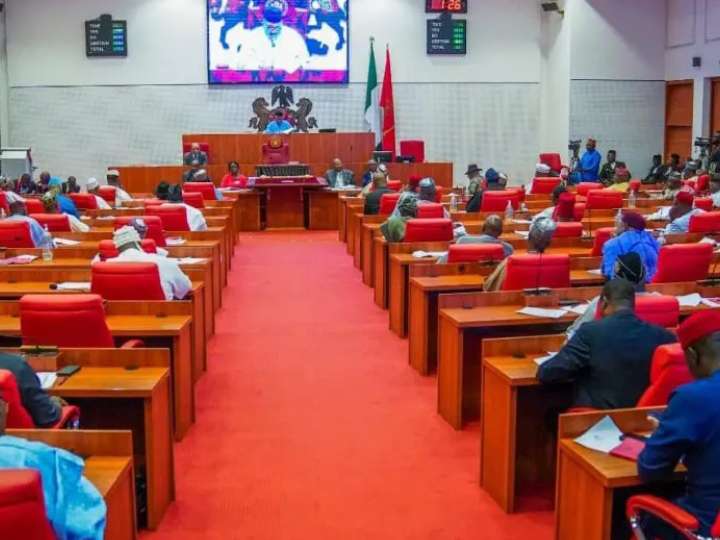
The Senate has declined to launch a separate investigation into the controversial Presidential Foreign Intervention Promotion Council (PFIPC), opting instead to await the outcome of an ongoing anti-corruption probe ordered by the Presidency. The decision has intensified public debate over budget accountability, institutional oversight, and how a body described by the Presidency as non-existent found its way into Nigeria’s 2026 Appropriation Act.
The controversy surrounding the Presidential Foreign Intervention Promotion Council (PFIPC) entered another significant phase on Wednesday after the Senate declined to open a fresh legislative investigation into the matter, choosing instead to await the outcome of an investigation already assigned to the Independent Corrupt Practices and Other Related Offences Commission (ICPC).
The decision came after a motion seeking a Senate inquiry into the alleged inclusion of about ₦1.3 billion for the council in the 2026 federal budget failed to secure the chamber’s approval.
Rather than initiating its own investigation, lawmakers argued that a parallel legislative exercise could duplicate ongoing efforts following President Bola Tinubu’s directive that the ICPC conduct a comprehensive investigation into the matter and report within 30 days.
The development has done little to calm public concerns.
Instead, it has shifted attention from whether another investigation should take place to broader questions about how Nigeria’s budget preparation, appropriation and oversight mechanisms operate.
Senate Declines Separate Legislative Investigation
The motion before the Senate sought to examine the circumstances surrounding the allocation reportedly made to the PFIPC in the 2026 Appropriation Act.
Lawmakers supporting the motion argued that public confidence required Parliament to independently determine how an organisation that the Presidency has publicly described as non-existent appeared in the national budget.
The motion also sought clarification on whether any public funds had been released under the budget line and whether any government officials played roles in facilitating the allocation.
After deliberations, however, the Senate resolved not to proceed with a separate investigation at this stage.
The chamber maintained that the executive had already activated the appropriate anti-corruption process by directing the ICPC to investigate the allegations.
As of the time of publication, the Senate has not announced plans for a future legislative inquiry beyond indicating it may review the matter after the anti-corruption agency concludes its investigation.
Why the PFIPC Controversy Has Attracted National Attention
The PFIPC controversy extends beyond the reported ₦1.3 billion allocation.
The matter raises difficult questions about the integrity of Nigeria’s public finance management system.
The Presidency has publicly stated that the Presidential Foreign Intervention Promotion Council is not an officially recognised government institution.
That declaration immediately created a governance dilemma.
If the council does not legally exist, observers have questioned how it became associated with a budget provision approved through the federal appropriation process.
What emerges from official statements is a growing concern that multiple layers of institutional checks may have failed if the allegations are ultimately substantiated.
Budget preparation in Nigeria typically involves ministries, departments and agencies submitting proposals before harmonisation, executive approval and eventual consideration by the National Assembly.
Each stage is expected to include verification mechanisms designed to prevent irregular entries.
The PFIPC controversy has therefore shifted attention from one budget line to the broader architecture of public financial accountability.
Presidency Orders ICPC Investigation
Before the Senate considered the motion, President Bola Tinubu had directed the ICPC to investigate the controversy.
According to official statements, the investigation is expected to determine whether criminal conduct occurred, including allegations relating to possible forgery, impersonation, abuse of official processes or other financial irregularities.
As of the time of publication, the ICPC has not publicly released its findings.
Authorities have not independently confirmed whether any public money was ultimately disbursed under the disputed allocation.
Equally, no court has determined criminal liability against any individual connected to the matter.
Those distinctions remain legally important.
An investigation is designed to establish facts rather than presume guilt.
Budget Accountability Under Fresh Scrutiny
The Senate’s decision has reopened longstanding conversations about transparency in Nigeria’s annual budgeting process.
Every federal budget passes through several institutional layers before receiving presidential assent.
Those stages are intended to identify duplication, irregular projects, inflated allocations and unauthorised agencies.
Yet controversies surrounding constituency projects, duplicated allocations and disputed budget insertions have surfaced repeatedly over the years.
The PFIPC case has become the latest example prompting renewed public scrutiny.
But beneath the surface lies an even more significant governance question.
If institutional safeguards function effectively, how should an allegedly non-existent entity appear within an approved federal budget?
That question remains central to ongoing public debate.
Governance Lessons Beyond the Immediate Controversy
Whether or not criminal wrongdoing is eventually established, governance experts argue that the controversy exposes the importance of stronger institutional controls.
Modern public finance systems depend heavily on documentation, verification procedures, internal audits and digital accountability mechanisms.
Where those safeguards become weak, opportunities emerge for administrative errors or, in more serious cases, fraudulent activities.
Nigeria has introduced several reforms over the years aimed at improving budget transparency, including digital procurement systems, treasury reforms and public finance management initiatives.
The effectiveness of those reforms is often measured not by policy announcements but by their practical ability to prevent questionable transactions before they occur.
That is one reason the PFIPC controversy has attracted sustained national attention.
It touches directly on public trust in institutions responsible for managing taxpayer resources.
Why the Senate’s Position Matters
The Senate’s refusal to commence its own investigation should not automatically be interpreted as a dismissal of the allegations.
Rather, lawmakers indicated that an executive-directed anti-corruption investigation is already underway and should be allowed to run its course.
This distinction is important.
The Senate has not declared the controversy resolved.
Neither has it publicly concluded that no wrongdoing occurred.
Instead, it has deferred legislative action pending the findings of the ICPC investigation.
Such an approach may reduce duplication of investigative efforts, although critics argue that Parliament retains an independent constitutional oversight responsibility separate from criminal investigations conducted by executive agencies.
That debate is likely to continue until the ICPC publishes its findings.
Public Confidence Depends on Transparent Outcomes
For many Nigerians, the controversy is about more than one disputed budget allocation.
It reflects broader concerns regarding accountability, institutional integrity and the protection of public resources.
Public confidence is strengthened when investigations are transparent, timely and evidence-based.
Equally, individuals or institutions connected to ongoing investigations remain entitled to due process and the presumption of innocence unless a competent court determines otherwise.
As of the time of publication, several critical questions remain unanswered.
Was any money released under the allocation?
How did the disputed budget entry emerge?
Were established verification procedures followed?
Could administrative failures have contributed to the controversy?
Those answers are expected to emerge from the ongoing investigation.
Until then, many of the claims circulating in public discourse remain subject to verification.
The Senate’s decision may have closed the door on an immediate parliamentary inquiry, but it has not ended national interest in the controversy.
Instead, attention now turns to the ICPC, whose findings could influence future legislative action, administrative reforms and broader conversations about transparency in Nigeria’s public finance system.
For citizens, the PFIPC controversy has become another reminder that effective governance is measured not only by the passage of budgets but also by the credibility of the institutions responsible for safeguarding public funds. Regardless of the eventual outcome of the investigation, the episode has underscored the need for stronger verification processes, greater institutional coordination and a public accountability framework capable of detecting and preventing questionable budget entries before they become national controversies.
Author Bio:
Smart Chuks is an investigative journalist and policy-focused writer at SaharaNews247, covering Nigerian politics, governance, security, economic developments, public accountability, institutional reform, and international affairs with a focus on transparency, evidence-based reporting, and public interest journalism.