
By Smart Chuks | SaharaNews247
Introduction
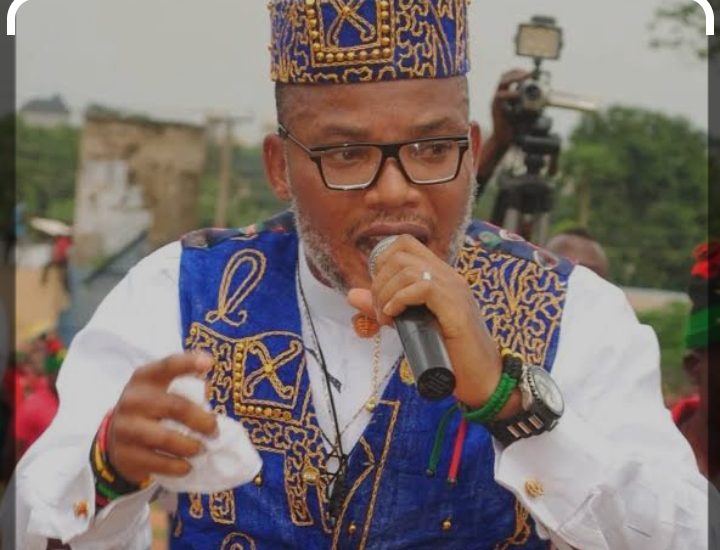
The leader of the Indigenous People of Biafra (IPOB), Mazi Nnamdi Kanu, has once again taken the Federal Government of Nigeria to court, demanding an end to his prolonged terrorism trial. His latest legal move has generated renewed debate across Nigeria, touching on human rights, judicial integrity, and the broader implications of prolonged political trials in democratic societies.
While social media platforms are abuzz with claims that Kanu has “sued the Federal Government and demanded discontinuation of his trial,” reliable news outlets and court updates indicate that the case remains ongoing. However, Kanu’s lawyers have indeed filed fresh motions challenging the legality of his continued prosecution and detention.
This article takes a factual and analytical look at what has actually transpired, the implications of the lawsuit, and what it means for Nigeria’s justice system and political landscape.
Background: Kanu’s Arrest and Prolonged Detention
Mazi Nnamdi Kanu’s name has dominated Nigeria’s political and judicial headlines since 2015 when he was first arrested on charges of treasonable felony. As leader of IPOB, a movement pushing for the secession of the southeast region, Kanu became a lightning rod for government scrutiny and national controversy.
After being granted bail in 2017, Kanu fled the country following a military operation in his hometown of Afaraukwu, Abia State. In June 2021, he was re-arrested and extradited to Nigeria under controversial circumstances from Kenya—a move that has since sparked multiple legal battles both in Nigeria and internationally.
Since then, Kanu has faced terrorism-related charges filed by the Department of State Services (DSS) and the Federal Ministry of Justice. His trial has been repeatedly adjourned, with several judges withdrawing or being reassigned. Despite multiple appeals and rulings questioning the legality of his extradition, the Federal Government has continued to prosecute the case.
The Latest Development: Kanu Sues the Federal Government
In recent days, reports surfaced claiming that Kanu filed a fresh lawsuit against the Federal Government, demanding the termination of his ongoing trial. According to his legal team, the suit was filed to challenge what they describe as “continuous violation of Kanu’s constitutional rights” and “abuse of court process.”
Sources within the defense allege that the Federal Government has consistently failed to comply with previous court rulings concerning his treatment and trial procedure. Among other things, Kanu’s lawyers argue that:
1. His extraordinary rendition from Kenya violated international law.
2. His detention conditions breach his right to a fair trial and adequate legal defense.
3. The prolonged delays and repeated adjournments amount to a denial of justice.
4. The terrorism charges lack sufficient legal grounding and were filed outside proper jurisdiction.
While the Federal Government has not publicly acknowledged any formal service of a new lawsuit, court insiders and human rights observers confirm that fresh motions have indeed been entered at the Federal High Court in Abuja by Kanu’s legal representatives.
Court’s Current Position
Despite the ongoing legal maneuvers, the court has not discontinued Kanu’s trial. In fact, as of October 24, 2025, the trial was adjourned to a later date after the defense team complained about limited access to case files.
Reports from Reuters and AP News confirm that the presiding judge maintained the charges remain valid and directed that proceedings continue. This contradicts some viral social media claims suggesting that the case had been terminated or withdrawn.
Therefore, while it is true that Kanu has moved to sue the government and demand an end to his trial, there is no legal confirmation yet that the trial has been stopped or that the Federal Government has acceded to his demand.
Legal and Political Analysis
The renewed legal battle raises fundamental questions about justice, human rights, and the independence of Nigeria’s judiciary. Kanu’s case has become a symbolic test of how far the Nigerian government is willing to go to assert national unity—and how the courts will balance that with constitutional protections.
1. Human Rights Dimension
Kanu’s legal team and supporters argue that his continuous detention without resolution violates both Section 35 of the Nigerian Constitution and Article 6 of the African Charter on Human and Peoples’ Rights, both of which guarantee personal liberty and fair trial.
The method of his extradition from Kenya has been a major point of contention. The United Nations Working Group on Arbitrary Detention had earlier called for Kanu’s release, declaring his detention illegal under international law.
2. Judicial Independence
The case has also raised concerns about judicial independence. With four different judges having presided over his matter at various stages, critics worry that political pressure may be undermining judicial impartiality.
The multiple adjournments and procedural delays have further strained public trust in Nigeria’s justice system, especially in high-profile political cases.
3. Political Implications
Politically, Kanu’s continued detention and trial have inflamed sentiments in Nigeria’s southeast region. Supporters see him as a political prisoner, while the government views his movement as a security threat.
The new lawsuit could reignite calls for dialogue and political settlement, especially as the 2027 general elections draw near and regional tensions continue to simmer.
Public Reaction and Social Media Frenzy
Following the news of Kanu’s latest lawsuit, social media platforms were flooded with posts claiming that the court had “discontinued the trial.” However, this has not been confirmed by any major legal or governmental authority.
Supporters of Kanu hailed the lawsuit as a courageous stand against oppression, while government loyalists dismissed it as a diversionary tactic. Civil rights organizations, including Amnesty International and CITAD, have urged the Nigerian government to ensure that due process is followed and that Kanu’s human rights are respected throughout the proceedings.
The Federal Government’s Response
The Federal Government, through the Office of the Attorney-General of the Federation (AGF), has maintained its stance that Kanu’s trial will proceed according to the law. Officials insist that the charges against him—centered on incitement, terrorism, and threats to national security—are too serious to be dropped without a conclusive judicial process.
Government representatives have also accused some IPOB members of continuing to incite violence and disrupt peace in the southeast, linking the group’s activities to attacks on public institutions.
The Bigger Picture: Justice, National Security, and Dialogue
Kanu’s case has become more than just a courtroom battle—it reflects the deep cracks within Nigeria’s national structure. The struggle between enforcing state authority and respecting citizens’ rights continues to define the country’s democratic maturity.
Many observers argue that while national security is critical, it should never come at the expense of justice and due process. The growing call for dialogue rather than confrontation suggests that Nigeria must rethink how it handles separatist movements and dissent in general.
As the case drags on, analysts believe that a fair, transparent, and lawful resolution will not only determine Kanu’s fate but also influence Nigeria’s reputation before the international community.
Conclusion
At the heart of Mazi Nnamdi Kanu’s lawsuit against the Federal Government lies a broader struggle for justice and accountability in Nigeria’s political and judicial systems. While the reports of his suit are credible, the claim that his trial has been discontinued is not yet supported by facts.
The courts have yet to rule on his fresh demands, and proceedings remain ongoing. Whether the government will relent or the judiciary will find merit in Kanu’s case remains to be seen.
For now, what stands clear is that Kanu’s legal fight continues to shape discussions on democracy, justice, and national unity in Nigeria.
Author Bio
Smart Chuks is a political affairs analyst and senior correspondent with SaharaNews247. He covers national politics, governance, and justice issues across Nigeria, with a focus on constitutional rights and public accountability. When he’s not writing, Smart enjoys mentoring young journalists and advocating for press freedom.