
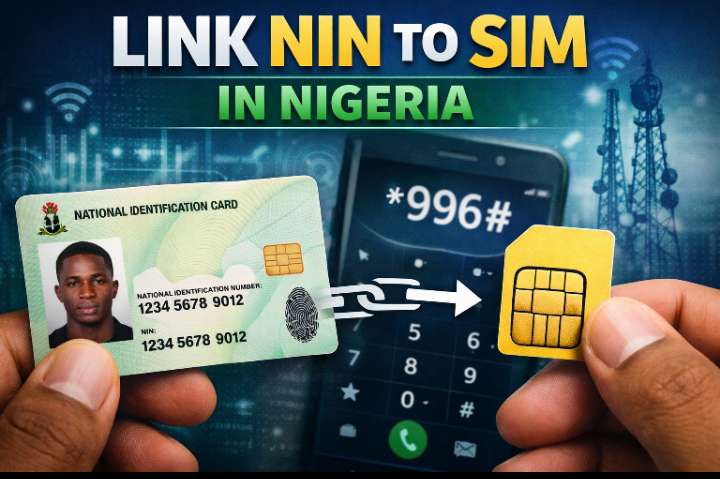
For millions of Nigerians, linking the National Identification Number (NIN) to their mobile phone lines has become one of the most important digital requirements in recent years. What started as a regulatory directive has evolved into a nationwide digital identity policy that now determines whether your SIM card remains active or gets blocked.
From banking transactions and social media verification to job applications and government services, the NIN-SIM linkage has quietly become one of the most powerful digital gatekeepers in Nigeria.
Yet, despite repeated announcements by the Nigerian Communications Commission (NCC) and network providers, many Nigerians are still confused about how the process works, which methods are valid, and what to do when errors occur.
This guide explains everything you need to know, in clear and practical terms.
Why NIN-SIM Linking Is Mandatory in Nigeria
The NIN-SIM policy was introduced as part of the Federal Government’s broader effort to strengthen national security, combat crime, reduce identity fraud, and build a unified digital identity system.
According to the NCC, the linkage helps law enforcement agencies track criminal activity, reduce cybercrime, and create a verifiable identity ecosystem across telecommunications, banking, and public services.
In practical terms, it means that every active SIM card in Nigeria must now be traceable to a verified individual.
Failure to comply leads to partial or total SIM restriction.
What Happens If You Don’t Link Your NIN to Your SIM?
If your NIN is not linked to your SIM, you may experience several restrictions. Outgoing calls can be disabled, data services may stop working, and in some cases, the SIM card may be permanently blocked.
For business owners, this can disrupt operations and customer communication. For students and job seekers, it can affect verification processes linked to online platforms. For everyday Nigerians, it simply means losing access to essential digital communication.
In today’s Nigeria, a blocked SIM is almost equivalent to being digitally disconnected from society.
What You Need Before You Start
Before attempting to link your NIN to your SIM, ensure you have your 11-digit NIN number, the phone number you want to link, a registered SIM card in your name, and access to your phone for OTP verification.
If you do not yet have a NIN, you must first enroll at a National Identity Management Commission (NIMC) center or through licensed agents across Nigeria.
Methods to Link NIN to SIM in Nigeria
There are three main ways to complete the process.
Linking via USSD Code (All Networks)
This is the fastest and most popular method.
Simply dial *996# on your phone and follow the on-screen instructions. You will be asked to enter your 11-digit NIN and confirm your phone number.
Once successful, you will receive a confirmation message.
This method works on MTN, Airtel, Glo, and 9mobile. It does not require internet access.
Linking via Network Websites or Mobile Apps
Each major network also provides an online portal for NIN linking.
MTN users can use the MyMTN App or the official MTN NIN portal.
Airtel users can use the Airtel Nigeria NIN registration page.
Glo users can visit the Glo NIN registration website.
9mobile users can complete the process on the 9mobile NIN page.
The process usually involves entering your phone number, inputting your NIN, receiving an OTP for verification, and submitting the form.
This method is ideal for people managing multiple phone lines.
Linking at Physical Service Centers
You can also complete the process by visiting any official network service center.
MTN Service Centers
Airtel Shops
Glo World Offices
9mobile Experience Centers
This option is recommended if you encounter technical issues, receive error messages, your NIN details do not match your SIM registration data, or your line has already been blocked.
You will be required to present a valid ID and your NIN slip.
Common Problems Nigerians Face and Their Solutions
One of the most common issues is the “NIN not found” error. This usually means your NIN has not been fully synced with the NIMC database or your enrollment process was incomplete. The solution is to visit a NIMC office for validation.
Another frequent problem is name mismatch. This happens when the name on your SIM registration does not match the name on your NIN. It may also be caused by spelling errors. The solution is to visit your network service center for data correction.
Some users also complain about not receiving OTP codes. This can be due to poor network signal, system congestion, or incorrect phone number input. In such cases, it is advisable to retry later or use a physical service center.
Can You Link One NIN to Multiple SIM Cards?
Yes, one NIN can be linked to multiple SIM cards, provided they belong to the same individual.
This is particularly useful for business owners, families, and individuals who use more than one network provider.
However, abuse of multiple registrations may trigger additional verification checks.
Is NIN-SIM Linking Safe?
From an official standpoint, the government maintains that the data is protected under Nigeria’s data protection regulations.
However, digital privacy experts advise Nigerians to avoid sharing their NIN publicly, use only official portals, be cautious of third-party agents, and never post their NIN on social media.
Your NIN is now one of your most sensitive digital assets.
Why This Policy Will Not Be Reversed
Many Nigerians believe the policy may be cancelled or relaxed in the future. However, this is highly unlikely.
Nigeria is gradually moving towards a fully integrated digital identity system where the NIN connects to BVN, voter ID, driver’s license, passport, and other national databases.
The SIM linkage is only the first layer of this system.
In the long term, the NIN will become Nigeria’s primary digital identity key.
Final Advice for Nigerians
If your SIM card is still active and not yet linked, it is advisable to complete the process immediately.
Telecom systems are becoming stricter, and reactivation after disconnection is becoming more difficult.
In modern Nigeria, digital identity is no longer optional. It is now a core part of everyday life.
Your NIN is no longer just a number. It is your digital citizenship.
Conclusion
The NIN-SIM linkage is not just another government policy. It represents Nigeria’s entry into the global digital identity era.
Whether you are a student, business owner, professional, or retiree, your phone number is now legally tied to your national identity.
Understanding and completing this process is no longer optional. It is a requirement of modern Nigerian life.
Author Bio
Smart Chuks is a Nigerian investigative journalist and digital media strategist with years of experience in online publishing, SEO journalism, and AdSense-compliant content development. He is the lead editor at SaharaNews247, where he focuses on long-form news analysis, public policy reporting, and digital growth strategies for African media platforms.