When residents of Elegbeka in Ondo State woke up to news that dozens of suspected terrorists had been arrested deep inside their forests, the story sounded almost unreal. Sokoto is over 900 kilometres away. Yet here were 39 men who reportedly fled the North-West after deadly military airstrikes and quietly settled inside a forest community in the South-West, hoping nobody would notice them.
It was a chilling reminder that Nigeria’s security crisis is no longer confined to any single region.
This report takes you behind the scenes of how the Ondo State Security Network Agency, known as Amotekun, uncovered the group, what investigators are saying so far, and what the development reveals about the shifting face of terrorism and organised crime in Nigeria.
By Smart Chuks
A Christmas Day That Changed Everything in Sokoto
On Christmas Day 2025, fighter jets struck remote forest enclaves in Sokoto State believed to be hideouts of extremist groups linked to the Islamic State. The operation was part of a broader counter-terrorism collaboration between Nigerian security forces and the United States.
Government officials described the strikes as precise and intelligence-driven, aimed at dismantling camps that had served as coordination points for violent groups operating across the North-West and parts of the Sahel.
But as explosions echoed through remote communities, something else was set in motion.
According to security sources, some of the fighters escaped the bombardment and began moving southward in small groups, blending into civilian traffic, abandoning familiar terrain and heading for forests far away from the epicentre of the strikes.
Their destination was not another northern state. It was Ondo.
From Sokoto to Ondo: How 39 Men Slipped Into the South-West
Days after the airstrikes, intelligence filtering into Ondo State suggested unusual movement of unfamiliar persons into forest areas around Ose Local Government. These were not farmers or hunters known to the local communities.
Amotekun officers intensified patrols around Elegbeka Forest, a vast stretch of woodland already notorious for kidnappings and highway robberies.
What they found was disturbing.
The men were not passing through. Their vehicles were hidden away from main roads, parked at a distance. Inside the forest, they had set up temporary hideouts and were quietly “hibernating”, according to the Amotekun commander, Chief Adetunji Adeleye.
They were arrested without resistance.
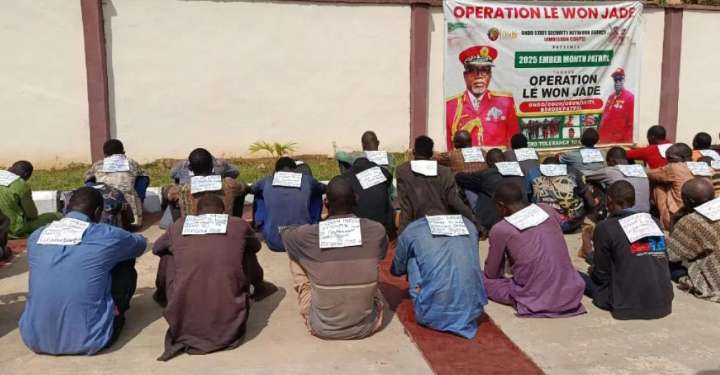
Thirty-nine suspects, aged between 18 and 45, were moved to the Amotekun headquarters in Akure for profiling and interrogation. Many reportedly admitted they were fleeing military pressure in Sokoto.
Why Elegbeka Forest Has Become a Criminal Magnet
For years, Elegbeka Forest has remained a nightmare for travellers. Its dense vegetation provides perfect cover for kidnappers and armed gangs who attack highways and retreat into the bush within minutes.
Amotekun had already established a permanent control post in the area because of repeated incidents involving abductions and robberies. Without that presence, the 39 suspects might have settled undetected for months.
This forest is a symbol of a larger problem facing Nigeria. As forests in the North come under military surveillance, criminal elements are migrating southwards, exploiting the fact that many southern forest reserves were never built with terrorism in mind.
What was once a local security challenge is now a national one.
The Displacement Effect: When Military Success Creates New Problems
Profiling the Suspects: What Authorities Are Looking For
At the Akure headquarters, investigators began the painstaking work of identifying who the suspects really are.
Officials say not everyone found in the forest will automatically be labelled a terrorist. The key focus is evidence. Those found with weapons, suspicious communication devices or materials linking them to extremist networks will face prosecution.
Others may be repatriated or released after investigations.
This approach is important. Nigeria has learnt painful lessons about wrongful arrests and profiling. Security agencies now tread more carefully, balancing urgency with respect for due process.
Not Just Terrorism: The Wider Security Sweep
The arrest of the 39 suspects came during a statewide ember-month operation that saw Amotekun pick up nearly 100 individuals for different crimes.
Some were linked to kidnapping, others to sexual offences and violations of open grazing laws. It was a reminder that insecurity in the South-West is not driven by terrorism alone. It is a web of criminality fed by poverty, porous borders and weak enforcement.
By parading 61 suspects publicly, Amotekun sent a message that the end-of-year lull would not be a free season for criminals.
One of the biggest lessons from this incident is the displacement effect of military operations.
When airstrikes hit Sokoto, the immediate target may have been destroyed, but the pressure did not end there. It simply shifted.
Criminal groups do not disappear overnight. They adapt. They move. They look for blind spots.
This is how bandits once pushed from Zamfara found their way into Niger and Kaduna. Now the same pattern is emerging between the North-West and South-West.
Without a coordinated national tracking system, today’s victory in Sokoto can become tomorrow’s crisis in Ondo, Ekiti or Osun.
The Power of Regional Collaboration
One positive takeaway from the Ondo arrests is the growing cooperation among South-West states.
Amotekun commands in Ondo, Ekiti, Osun and Ogun now share intelligence and conduct joint patrols along their borders. This is how the suspects were quickly flagged once they crossed into Ondo.
It is a silent revolution in Nigeria’s security architecture. For decades, states waited for federal agencies to act. Today, they are building their own networks, plugging gaps that criminals once exploited.
What This Means for Ordinary Nigerians
For residents of Ondo, the news was both reassuring and unsettling.
Reassuring because Amotekun worked. Unsettling because it proved how close danger can come without warning.
Many farmers around Ose Local Government have long complained of strange movements in the forest. This incident may finally convince authorities to invest more in forest surveillance and rural policing.
It is also a wake-up call for travellers. Forest highways once considered safe now require constant vigilance.
Rethinking Security in Nigeria
The Ondo arrests raise deeper questions about how Nigeria handles internal security.
Should forest reserves continue to exist without modern surveillance systems?
Are regional security outfits receiving enough training and equipment?
How do we ensure that displaced criminal groups are tracked across state lines in real time?
Experts argue that Nigeria needs a national forest security strategy that integrates satellite monitoring, drones and community intelligence. Without this, criminals will keep hopping from one region to another.
What Comes Next
Amotekun has announced a new phase of operations starting in January, with round-the-clock patrols and expanded forest ranger deployment.
Security agencies say investigations into the 39 suspects are ongoing and results will be made public.
But beyond arrests and patrols, this incident has exposed a fragile truth. Nigeria’s battle against terrorism is not only about bombs and guns. It is about mobility, terrain, and the ability of criminals to reinvent themselves faster than the system can respond.
Conclusion
The story of 39 men fleeing Sokoto and hiding in Ondo forests is not just a crime report. It is a mirror held up to Nigeria’s evolving security reality.
It shows how a strike in one corner of the country can ripple across regions, how forests once seen as harmless now shelter dangerous networks, and how local security initiatives like Amotekun are becoming frontline defenders in a complex war.
For now, Ondo can breathe a little easier. But the larger question remains. Where will the next group run to when the next airstrike hits?
About the Author
Smart Chuks is a senior investigative journalist with SaharaNews247, reporting on security, governance and conflict across Nigeria. With over a decade of experience in field reporting and policy analysis, he brings a human-centred perspective to stories that shape national discourse.