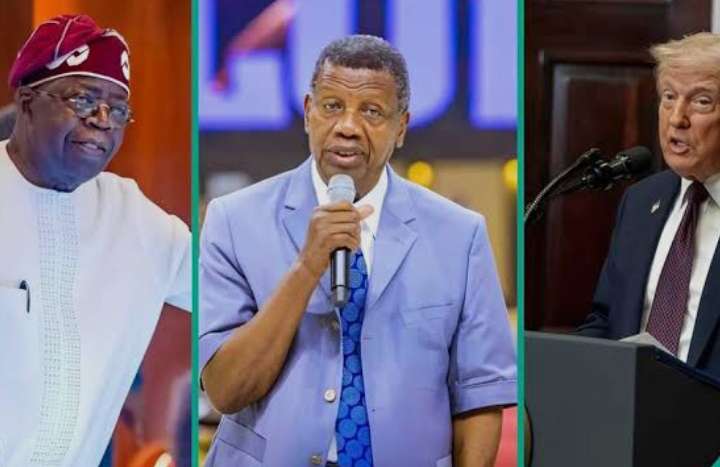
Nigeria’s political and diplomatic space was thrown into debate after reports emerged that Pastor Enoch Adeboye, the General Overseer of the Redeemed Christian Church of God (RCCG), advised President Bola Ahmed Tinubu to appeal to U.S. President Donald Trump for a 100-day delay in any planned U.S. military action against Nigeria.
According to multiple Nigerian media outlets, Adeboye made the call in response to Trump’s alleged directive to the Pentagon to prepare for a possible military intervention in Nigeria over attacks on Christian communities. The revered cleric reportedly urged Tinubu to use diplomacy to secure 100 days of grace and, within that period, give Nigeria’s service chiefs 90 days to eliminate terrorists and their sponsors.
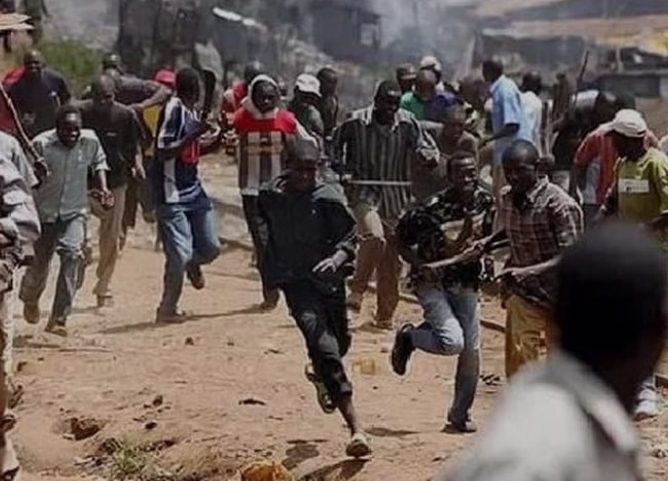
This report has generated intense reactions, not just because of its political implications, but also because it highlights Nigeria’s fragile security architecture and the tense relationship between faith, governance, and foreign policy.
What Adeboye Reportedly Said
Reports from Freedom Online, Independent.ng, and Legit.ng indicate that Pastor Adeboye made a passionate appeal to President Tinubu, saying:
“Find a way to convince the President of America to please delay his action for about 100 days. Within that time, tell your service chiefs to eliminate terrorists and their sponsors within 90 days or resign.”
Adeboye’s comments, which were delivered during a sermon, came amid rising fears over President Trump’s warning that the U.S. could intervene militarily in Nigeria if the killings of Christians continue.
Though the full transcript of Adeboye’s sermon is yet to be released by the RCCG, several credible news outlets have quoted similar statements, giving the report significant weight. The cleric’s message appears to be both spiritual and strategic—calling for diplomacy abroad and decisive leadership at home.
Background: The U.S. Military Threat
The current tension traces back to comments made by President Donald Trump, who accused the Nigerian government of failing to protect Christian minorities from violent attacks. He reportedly instructed the U.S. Department of Defense to “prepare all necessary plans” for potential action, describing the situation as “an unacceptable wave of persecution.”
Nigeria’s federal government immediately rejected Trump’s comments, describing them as “a distortion of facts and a threat to national sovereignty.” Officials emphasized that Nigeria’s security challenges stem from terrorism and banditry, not a religious war. Both Christians and Muslims, the government argued, have been victims of insecurity across the nation.
International observers have also cautioned against framing Nigeria’s crisis solely in religious terms, noting that the underlying issues are far more complex — including poverty, weak governance, and the proliferation of arms in the Sahel region.
Why Adeboye’s Message Matters
Pastor Adeboye’s advice carries both symbolic and strategic weight. As one of Nigeria’s most respected religious leaders, his words resonate beyond the pulpit. By calling for a diplomatic delay, he highlights the need for dialogue over confrontation — a pragmatic approach that could help Nigeria avoid unnecessary escalation with the United States.
The 100-day window is more than a request for time; it is a call for accountability. By urging Tinubu to demand results from the service chiefs within 90 days, Adeboye echoes the frustration of millions of Nigerians who are weary of insecurity, kidnappings, and terrorist attacks that have plagued the nation for years.
The message also underscores a painful truth: Nigeria cannot rely solely on faith or foreign sympathy. It must take full responsibility for its security and governance.
The Religious and Political Balance
Adeboye’s message reflects the fine line between religious influence and political intervention. While he spoke as a spiritual leader, his comments touch directly on state affairs. This dual role makes his statement both sensitive and powerful.
By warning that “China and Russia will not defend us,” Adeboye reminded Nigerians that in global politics, alliances are driven by interests, not sentiment. It was a subtle call for national unity — urging Nigerians to rise above political and religious divides in the face of external threats.
The Legal and Diplomatic Realities
Under international law, a unilateral U.S. military intervention in Nigeria would be highly controversial. It would require either United Nations approval or consent from the Nigerian government — neither of which currently exists.
This means any U.S. “operation” would be more of a political signal than an imminent invasion. Adeboye’s advice, therefore, can be viewed as a diplomatic safeguard — urging Tinubu to use dialogue and persuasion to buy time while demonstrating that Nigeria can handle its internal issues.
What Nigeria Should Do Next
1. Strengthen diplomacy:
The Tinubu administration must engage Washington through transparent dialogue, presenting credible progress reports on counterterrorism and human rights. Nigeria’s Ministry of Foreign Affairs should coordinate with regional and international allies to prevent external interference.
2. Demand accountability from security chiefs:
Adeboye’s 90-day challenge is a timely reminder that leadership without results is unacceptable. Service chiefs must deliver measurable progress — not excuses. Intelligence operations, community engagement, and military coordination must improve drastically.
3. Promote unity and responsible communication:
Religious leaders play a vital role in shaping public opinion. At this delicate time, influential voices like Adeboye’s can help promote calm, resilience, and faith in collective national responsibility rather than panic or division.
Conclusion
Pastor Enoch Adeboye’s reported message to President Bola Tinubu goes beyond religion — it is a strategic plea for diplomacy, accountability, and national unity. His words reflect both concern and wisdom: urging Nigeria’s leaders to take control of the country’s destiny rather than leave it to external powers.
While some may view his comments as politically charged, they also serve as a wake-up call for action. The time for excuses is over — Nigerians deserve security, stability, and leadership that protects their interests both at home and abroad.
In the coming weeks, all eyes will be on how Tinubu’s government responds. Will it rise to the challenge and deliver visible results within Adeboye’s 90-day window? Or will it allow international pressure and domestic insecurity to deepen Nigeria’s vulnerabilities?
The answer will shape not just the future of this administration, but the direction of the entire nation.
Author Bio
Smart Chuks is a senior political and security correspondent at SaharaNews247. With over a decade of experience reporting on West African politics, defense, and governance, he is passionate about promoting transparency, peace, and national development.