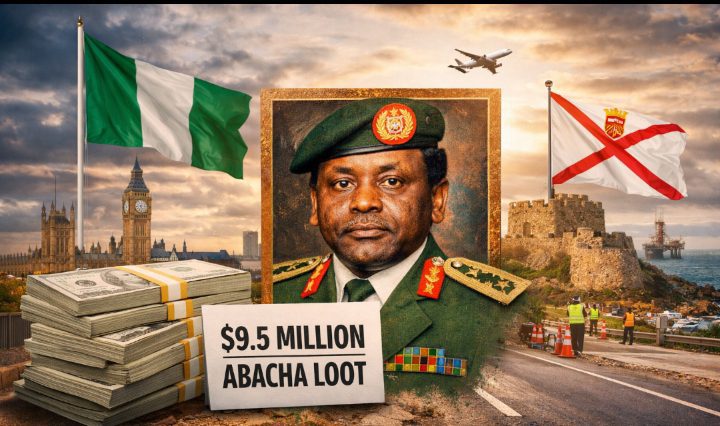
On a quiet weekday morning in Abuja, the news filtered through government offices and media houses that another slice of Nigeria’s stolen wealth was finally on its way home. The figure was modest compared to the billions looted in the 1990s, yet the symbolism was powerful. More than $9.5 million linked to the late General Sani Abacha’s regime has been approved for repatriation from Jersey, a British Crown Dependency that has become one of Nigeria’s most reliable partners in recovering illicit funds.
For many Nigerians, Abacha’s name belongs to a painful chapter they would rather forget. But the truth is that the consequences of his regime still shape everyday life, from broken highways to hospitals that never received the funding meant for them. This latest recovery is therefore more than a financial transaction. It is a reminder that corruption has a long memory, and so should accountability.
How the Money Was Found
The funds were sitting quietly in a Jersey bank account, buried beneath layers of shell companies and corporate structures that had been set up decades ago. Using its civil forfeiture laws, Jersey’s Royal Court ruled that the money was more likely than not derived from corruption linked to the Abacha era.
This legal route matters. Unlike criminal trials, civil forfeiture allows authorities to seize assets even when the original perpetrators are no longer alive or cannot be prosecuted. In the Abacha case, where many of the key actors have died, this tool has proven invaluable.
By December 2025, Nigerian and Jersey officials had signed a formal agreement outlining how the money would be returned and how it must be spent. The British High Commission in Abuja played a facilitative role, ensuring that all diplomatic and legal hurdles were cleared.
Why It Took So Long
Some Nigerians have asked a fair question. If the money was identified years ago, why is it only being returned now?
The answer lies in the complexity of international asset recovery. Each jurisdiction has its own courts, procedures and appeal processes. The Abacha family and their associates contested many seizures, arguing that the funds were legitimate earnings. Every objection had to be heard, every document reviewed, every legal avenue exhausted.
What looks like a simple wire transfer on paper often represents years of courtroom battles, forensic accounting and diplomatic negotiation behind the scenes.
From Swiss Vaults to Island Banks
Jersey is not the first place Nigeria has recovered Abacha loot from. Over the years, funds have been traced to Switzerland, the United States, Liechtenstein and Luxembourg. Yet Jersey stands out because of its consistency. The island has already returned hundreds of millions of dollars to Nigeria, money that went into landmark projects like the Second Niger Bridge and sections of the Lagos-Ibadan Expressway.
These are not abstract achievements. Every motorist who crosses the Niger Bridge today is, in a small way, benefiting from money that was once hidden in foreign accounts.
Why the Abuja-Kano Road Was Chosen
This fresh $9.5 million will be channelled into the Abuja-Kano Road, one of Nigeria’s most strategic highways. Anyone who has travelled that route understands why it matters.
The road connects the federal capital to Kano, the economic heartbeat of the North. For farmers transporting produce, traders moving goods and families travelling across regions, the Abuja-Kano Road is more than asphalt. It is a lifeline.
Years of delays, security concerns and funding gaps have slowed its completion. The recovered funds will not finish the entire road, but they will help close a critical funding gap and push the project closer to reality.
Trust, the Missing Ingredient
Despite the good news, many Nigerians are uneasy. They have heard similar announcements before. Money is recovered, projects are named, and then silence follows.
In 2023, a Nigerian court ordered the federal government to account for how billions of dollars in recovered Abacha funds were spent. That ruling captured a national mood. People are no longer satisfied with headlines. They want evidence, timelines and measurable outcomes.
For this latest $9.5 million, the real story will begin after the money lands in Nigeria. Will citizens be able to trace it to visible progress on the Abuja-Kano Road, or will it vanish into paperwork and contractor claims?
Why Asset Recovery Still Matters
It is tempting to dismiss $9.5 million as small change in a country of over 200 million people. But recovered loot is different from loans or foreign aid. It is money that was taken from Nigerians and is now being returned.
In a time of budget cuts, rising debt and economic uncertainty, every recovered dollar has an impact. More importantly, each successful recovery sends a message to today’s power holders that the world is watching and that stolen wealth can follow them across borders and decades.
A Wound That Refuses to Heal
For those who lived through the 1990s, corruption was not an academic debate. It was felt in empty classrooms, abandoned hospitals and roads that turned into death traps every rainy season.
The Abacha regime did not just steal money. It stole time, opportunity and dignity. That is why, years later, the return of even a fraction of what was lost stirs deep emotions.
What Comes Next
Nigeria’s fight to recover stolen assets is far from over. Investigators believe more Abacha-linked funds remain hidden abroad. But the focus must now expand beyond recovery to reform.
The country needs transparent systems that show citizens how recovered funds are spent, project by project. It needs stronger institutions that prevent a repeat of history. And it needs leaders who understand that accountability is not a favour but a duty.
A Moment of Reckoning
The $9.5 million from Jersey is a small victory in a very long war. It will not rebuild Nigeria, but it can help restore a little faith if handled well.
The asphalt laid with this money on the Abuja-Kano Road will speak louder than any press release. It will tell Nigerians whether the era of stolen wealth is truly ending, or merely being recycled under a different name.
About the Author
Smart Chuks is a senior investigative correspondent with SaharaNews247. He writes on governance, public finance and development, with a focus on how policy decisions affect ordinary Nigerians. With over a decade in the newsroom, he believes journalism should not only inform, but also hold power to account.