SaharaNews247 | November 20, 2025
By Smart Chuks
In a development that has stirred debate within Nigeria’s defence community and among security policy observers, the Nigerian Army has confirmed the dismissal of four soldiers deployed to counter-insurgency operations in the North-East over what it described as “disobedience to a standing order.”
The decision, which became public through internal military correspondence and was later acknowledged by defence sources, comes at a sensitive moment in Nigeria’s long-running war against Boko Haram and the Islamic State West Africa Province (ISWAP). It has reopened critical conversations around military discipline, operational accountability, frontline morale, and the structural pressures facing the Armed Forces in an increasingly complex conflict environment.
While the Army has not released a detailed public statement explaining the exact circumstances that led to the dismissals, the case has attracted national attention due to its timing, the nature of the sanctions imposed, and the broader security context in which it occurred.
What Is Officially Known
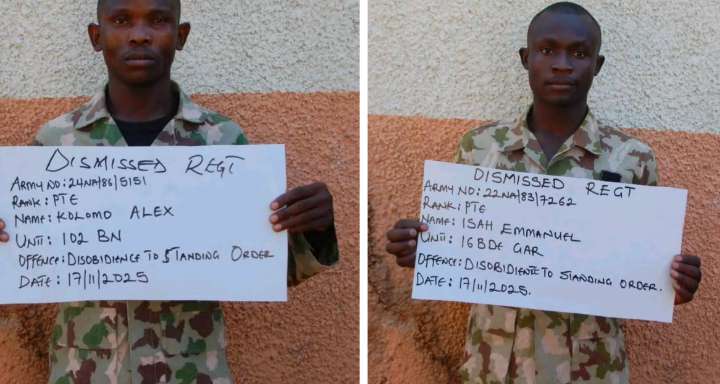
According to multiple defence and military sources familiar with the matter, the four dismissed personnel were serving in active operational units in the North-East theatre. Internal documents circulating within military channels identified them as:
Mukaila Mutari
Isah Emmanuel
Kolomo Alex
Ibrahim Musa
The dismissal letters were reportedly issued on November 17, 2025, following what military authorities described as a breach of established operational protocols, formally referred to as “standing orders.”
Standing orders within the Nigerian Army are binding operational directives that regulate troop conduct, movement, engagement rules, internal communication, and battlefield procedures. These orders are considered foundational to military discipline and are designed to ensure operational coherence, command control, and the safety of personnel.
However, the Army has not publicly disclosed:
The specific standing order that was violated.
Whether a full court-martial was conducted.
Whether the decision followed a formal investigation process or summary disciplinary action.
Whether the dismissed soldiers were given the opportunity to appeal.
This absence of detailed official clarification has contributed to widespread speculation, both within military circles and among security analysts.
The Security Context: A War Under Pressure
The dismissals occurred at a period of heightened operational strain in Nigeria’s counter-insurgency campaign.
In the weeks preceding the incident, insurgent groups had intensified attacks across parts of Borno, Yobe, and Adamawa states. Military convoys were reportedly ambushed, patrol units targeted, and several communities experienced renewed displacement due to escalating violence.
Security sources also confirmed the killing of a senior Nigerian Army officer during an encounter with insurgents in the same operational zone, further underscoring the volatile environment in which frontline troops are currently operating.
The North-East conflict, now in its sixteenth year, has evolved into a complex hybrid war involving guerrilla tactics, intelligence warfare, cross-border insurgent movements, and civilian-military engagement challenges. Despite sustained military operations, Boko Haram and ISWAP have demonstrated continued capacity to regroup, adapt, and mount attacks against both military and civilian targets.
Within this context, command decisions—particularly disciplinary ones—carry far-reaching implications beyond individual cases.
Discipline in War: The Military Imperative
From a doctrinal standpoint, military discipline is non-negotiable. Modern armed forces function on strict hierarchical command structures, where obedience to standing orders is essential for:
Maintaining unit cohesion.
Preventing operational breakdown.
Protecting civilian populations.
Avoiding friendly-fire incidents.
Safeguarding classified tactical information.
Disobedience in a combat environment can compromise entire missions, expose units to ambush, and undermine broader strategic objectives. In this sense, the Nigerian Army’s decision to enforce disciplinary measures aligns with established global military norms.
Every professional armed force—from the United States military to NATO structures—operates under similar disciplinary frameworks, where breaches of standing orders are treated as serious offences, particularly in active war zones.
However, the scale and finality of the punishment—outright dismissal—has prompted deeper institutional reflection.
Morale on the Frontline
While discipline sustains military structure, morale sustains military effectiveness.
Frontline Nigerian soldiers in the North-East operate under extreme conditions: prolonged deployments, exposure to ambushes, harsh terrain, psychological stress, limited rest cycles, and persistent uncertainty. For many, the operational environment is one of continuous high-risk engagement with insurgents who blend into civilian populations and employ asymmetric warfare tactics.
Within this reality, disciplinary actions are not merely administrative decisions; they send powerful signals across the ranks.
Security analysts warn that if frontline soldiers perceive disciplinary systems as opaque, arbitrary, or disproportionately punitive, the consequences may include:
Erosion of trust in command leadership.
Reluctance to take initiative during combat.
Operational hesitation in high-pressure situations.
Psychological disengagement from mission objectives.
A professional military must enforce discipline, but it must also protect the institutional morale of those who bear the operational burden of national security.
Transparency and Public Accountability
Nigeria’s Armed Forces operate within a democratic system where public accountability and institutional legitimacy are critical components of national security governance.
The military is routinely scrutinised by:
Civil society organisations.
International human rights bodies.
Conflict monitoring agencies.
Families of serving personnel.
In such an environment, major disciplinary actions—especially those involving dismissal from service—carry public interest implications.
Security governance experts argue that greater transparency in disciplinary processes strengthens:
Public confidence in the military.
Institutional credibility.
Internal troop morale.
Civil-military relations.
While operational secrecy remains necessary in active conflict zones, limited non-sensitive disclosures—such as confirmation of investigative procedures, legal frameworks applied, and rights of affected personnel—can help balance security needs with public accountability.
Legal and Institutional Framework
Under Nigeria’s Armed Forces Act, disciplinary actions against military personnel are typically guided by established procedures, which may include:
Summary trials for minor offences.
Court-martial proceedings for serious violations.
Administrative reviews by commanding officers.
Appeal mechanisms within the military justice system.
Dismissal from service represents one of the most severe sanctions available under military law. It is usually reserved for offences considered incompatible with continued service, including gross misconduct, insubordination, desertion, or actions that jeopardise national security.
Without official clarification on whether a court-martial was conducted in this case, questions remain regarding the procedural pathway that led to the final decision.
Operational Impact
Beyond legal and moral considerations, the dismissals also have practical operational implications.
Counter-insurgency warfare relies heavily on institutional memory and field experience. Soldiers deployed in high-conflict zones develop tactical awareness that cannot be easily replicated through training alone. Removing experienced personnel from active units can affect:
Unit continuity.
Operational coordination.
Field intelligence familiarity.
Manpower strength in critical sectors.
At a time when Nigeria continues to stretch military resources across multiple internal security theatres—including banditry in the North-West, communal conflicts in the Middle Belt, and separatist tensions in the South-East—every trained soldier represents a strategic asset.
Strategic Significance for Nigeria’s Security Architecture
The dismissal of the four soldiers reflects deeper structural tensions within Nigeria’s security ecosystem.
It highlights the delicate balance between:
Discipline and adaptability.
Command authority and frontline autonomy.
Institutional control and operational flexibility.
Justice and morale.
Modern counter-insurgency warfare increasingly requires decentralised decision-making, rapid tactical responses, and situational judgment under unpredictable conditions. Rigid command frameworks, while essential for discipline, must also adapt to the fluid realities of irregular warfare.
Security experts argue that Nigeria’s military doctrine may need continued reform to reflect the evolving nature of contemporary conflicts—where intelligence, technology, civilian engagement, and psychological resilience play roles as critical as firepower.
onclusion
The dismissal of four Nigerian soldiers over alleged disobedience to standing orders represents more than an internal military disciplinary action. It is a window into the broader challenges confronting Nigeria’s defence institutions as they wage one of the longest-running counter-insurgency campaigns in Africa.
Discipline remains a cornerstone of military professionalism. Yet, discipline without transparency risks undermining trust. Punishment without procedural clarity risks eroding morale. And command authority without adaptive reform risks weakening operational effectiveness.
As Nigeria continues to confront insurgency, banditry, and internal security threats, the long-term success of its military strategy will depend not only on battlefield victories, but on the strength of the institutions that govern those battles—and the human beings who fight them.
About the Author
Smart Chuks is a Nigerian investigative journalist and security affairs analyst with extensive experience covering defence, governance, and conflict-related issues across West Africa. He is the publisher of SaharaNews247 and writes on military policy, national security, and public accountability.