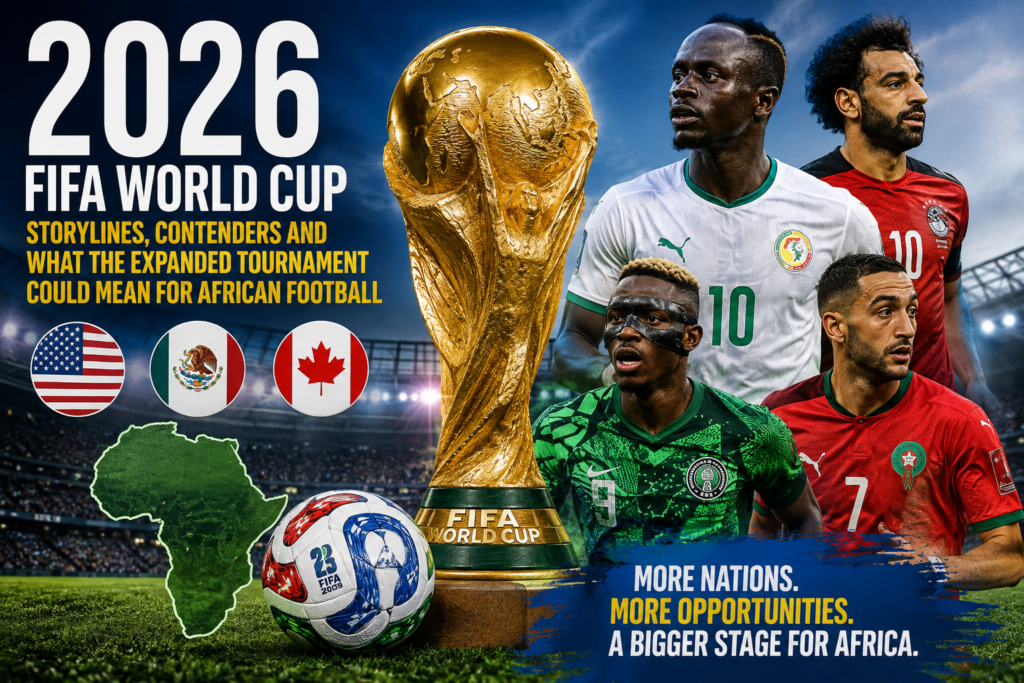
The tournament, jointly hosted by the United States, Canada and Mexico, delivered the biggest World Cup in history, with 48 teams competing across 104 matches. Spain ultimately lifted the trophy after defeating defending champions Argentina 1–0 after extra time in the final at New York New Jersey Stadium on July 19.
Yet for Africa, the most important story was not simply whether the continent could produce another historic semi-finalist after Morocco’s breakthrough in Qatar in 2022. The 2026 tournament provided a broader test: could a larger African presence translate into deeper collective progress, stronger performances against elite opposition and evidence that the continent’s competitive depth is improving?
The results did not produce the breakthrough Africa ultimately wants, but they provided stronger evidence that the continent’s competitive depth is improving.
Nine African nations reached the Round of 32, a record that demonstrated the immediate competitive effect of expanded representation. Algeria, Cabo Verde, Côte d’Ivoire, the Democratic Republic of Congo, Egypt, Ghana, Morocco, Senegal and South Africa all advanced from the group stage. CAF described the achievement as the first time that 90 per cent of Africa’s participating nations had progressed from the World Cup group stage.
Morocco went furthest, reaching the quarter-finals for a second successive World Cup and becoming the first African nation to accomplish that feat. The Atlas Lions ultimately lost 2–0 to France, but their campaign reinforced the argument that Morocco’s 2022 semi-final was not an isolated accident.
For African football, that may be the most important lesson of all.
The 2026 World Cup did not produce an African finalist or champion. It did something potentially more consequential: it showed that a larger number of African teams can compete successfully in the same tournament and that at least one African side can establish itself as a consistent presence in the latter stages.
That changes the conversation.
Spain’s Triumph Marked the End of Argentina’s Reign
The World Cup ended with Spain becoming world champions for the second time.
Luis de la Fuente’s side defeated Argentina 1–0 after extra time in a final that brought together the reigning world champions and one of the strongest European teams of the tournament. Ferran Torres scored the decisive goal in the 106th minute after Nico Williams created the opportunity with a header down at the far post.
Argentina had entered the competition attempting to become only the third nation to successfully defend the World Cup since the tournament began in 1930. That ambition ultimately ended in the final.
Spain’s victory also reinforced a broader feature of modern international football: sustained investment in technical development, tactical education and elite player production can create national teams capable of competing consistently at the highest level.
The result was not merely a change of champion. It provided another reminder that international football increasingly rewards systems rather than individual brilliance alone.
That lesson is particularly relevant to Africa.
For decades, African countries have produced extraordinary individual players. The challenge has been creating national-team structures capable of consistently converting that talent into deep World Cup runs.
The 2026 tournament provided encouraging evidence that this problem is beginning to change, although it is far from solved.
The 48-Team World Cup Changed the Competitive Landscape
The expansion from 32 to 48 teams fundamentally changed the structure of the World Cup.
The 2026 tournament featured 12 groups of four teams, followed by a new Round of 32 involving the top two teams from each group and the eight best third-placed sides. The competition ultimately comprised 104 matches, making it the largest World Cup ever staged.
The expansion had been debated extensively before the tournament.
Supporters argued that a global sport should provide more nations with access to its most important competition. Critics worried that adding teams could reduce competitive quality and create more mismatches.
The African experience provides one of the clearest pieces of evidence in that debate.
Africa entered the expanded tournament with more representatives than ever before, and nine of them survived the group stage.
That does not automatically prove that expansion has eliminated the competitive gap between Africa and the traditional football powers. It does, however, demonstrate that broader access can produce meaningful competitive opportunities when teams are adequately prepared.
The critical question now is whether those opportunities can be converted into long-term development.
Africa’s Nine-Team Breakthrough Was Bigger Than a Statistic
The most striking African achievement of the tournament was the collective performance.
Algeria, Cabo Verde, Côte d’Ivoire, DR Congo, Egypt, Ghana, Morocco, Senegal and South Africa all reached the Round of 32.
That achievement mattered because it moved the conversation away from the performance of one exceptional team.
In previous tournaments, African football’s reputation often depended heavily on the fortunes of one or two leading nations. Morocco’s run to the semi-finals in Qatar was historic, but it was still possible to view it as the achievement of a particularly well-organised generation.
The 2026 World Cup offered a different picture.
A much larger group of African teams demonstrated that the continent’s competitive base is broadening.
That does not mean all nine nations were equally close to challenging for the trophy. They were not. Their final positions and knockout performances varied considerably.
But collectively, they showed that African teams are increasingly capable of surviving the group stage, adapting to different opponents and competing successfully within a tournament structure that gives more countries a genuine route into the knockout rounds.
That is an important development for CAF.
Morocco Confirmed That Qatar 2022 Was Not a One-Off
Morocco remains the central case study in Africa’s changing football fortunes.
In Qatar in 2022, Morocco became the first African nation to reach a World Cup semi-final. Its victories over Spain and Portugal changed the psychological boundaries surrounding African football.
The question entering 2026 was whether that success could be repeated or whether the 2022 campaign would remain an exceptional high point.
Morocco did not reach the semi-finals this time.
But the Atlas Lions still produced one of the strongest African performances in World Cup history, reaching the quarter-finals for a second consecutive tournament. FIFA noted that Morocco became the first African side to reach the last eight at two successive World Cups.
That consistency may ultimately be more important than another isolated semi-final appearance.
Morocco entered the 2026 tournament under a new coach, Mohamed Ouahbi, who had replaced Walid Regragui in March. Ouahbi had already demonstrated his ability to develop young talent by leading Morocco to the FIFA U-20 World Cup title in 2025.
The transition did not derail the national team.
Morocco finished second in its group after drawing with Brazil and defeating Scotland and Haiti. In the knockout phase, the Atlas Lions eliminated the Netherlands on penalties after a 1–1 draw before defeating co-hosts Canada 3–0. France then ended Morocco’s campaign with a 2–0 quarter-final victory.
That sequence is significant because Morocco’s second consecutive deep World Cup run suggests that its 2022 semi-final was not simply the product of one exceptional tournament cycle.
Nigeria possesses one of Africa’s deepest football cultures and a large pool of players operating in major European leagues. Yet the Super Eagles were not among the nine African nations that reached the 2026 tournament’s Round of 32.
Morocco’s progress increasingly looks less like an isolated tournament success and more like the product of sustained investment in player development, coaching and national-team structures.
Morocco’s recent progress has been accompanied by sustained attention to player development, coaching and football infrastructure, while its national teams have benefited from a strong pool of players competing in European leagues. The challenge is now to maintain that performance across successive generations rather than allowing one successful cycle to become an isolated achievement.
The real challenge now is maintaining that level over several generations.
The African Football Question Is No Longer About Talent
Africa has never suffered from a shortage of football talent.
From George Weah and Samuel Eto’o to Didier Drogba, Yaya Touré, Jay-Jay Okocha, Nwankwo Kanu, Mohamed Salah and Sadio Mané, the continent has repeatedly produced players capable of competing at the highest level.
The deeper problem has been converting individual excellence into sustainable national-team success.
A country can produce elite forwards while still struggling with coaching structures. It can have outstanding midfielders while operating a poorly organised domestic league. It can have world-class defenders while lacking adequate training infrastructure for the next generation.
The modern World Cup therefore exposes more than a team’s technical quality.
It tests preparation, sports science, tactical planning, squad management, federation organisation, travel logistics, medical support and the ability of coaches to make adjustments against different opponents.
That is why the 2026 African performance deserves to be studied as a systems question rather than simply celebrated as a collection of results.
Nigeria’s Absence Remains a Major Part of the African Story
For Nigerian football, the 2026 World Cup produced a painful contradiction.
That absence matters because Nigeria’s football ambitions cannot realistically be separated from the country’s enormous influence on African football.
Nigeria has historically been one of the continent’s leading football nations. The country has produced generations of internationally recognised players and has repeatedly competed successfully at continental level.
But individual talent does not guarantee World Cup success.
The Nigerian case illustrates the importance of administration, technical planning, youth development and consistency.
A national team can have talented players scattered across elite European clubs and still struggle to build a coherent international identity.
That should be one of the major lessons Nigeria takes from the 2026 tournament.
The question is not whether Nigeria has enough talented footballers.
It is whether the country has built an institutional football system capable of consistently turning that talent into results.
That question extends from the national team to youth football, domestic competitions, coaching education, scouting, sports science and football administration.
Senegal and the Importance of Competitive Depth
Senegal also provided an important case study in how difficult the expanded knockout structure can become.
The Lions of Teranga reached the Round of 32 but ultimately finished 31st in FIFA’s final tournament standings. Their campaign included a dramatic elimination by Belgium after Senegal had appeared to be on course for victory before a late comeback and extra-time penalty changed the outcome.
Senegal’s experience demonstrates that getting more African teams through the group stage does not automatically guarantee deeper progress.
The knockout rounds remain unforgiving.
A single defensive lapse, a late goal or a moment of individual quality can end an otherwise impressive campaign.
That is why African football’s next objective should not simply be increasing the number of teams reaching the knockout rounds.
The bigger objective is developing enough depth and consistency to ensure that several African nations can survive multiple knockout rounds.
The Expanded Tournament Created a Historic African Platform
The commercial significance of the expanded World Cup is enormous.
Before the tournament, FIFA approved a record financial distribution of USD 871 million to the 48 participating member associations. The package included USD 2.5 million in preparation money for each participating association and USD 10 million in qualification money, alongside additional contributions covering delegation costs and ticketing.
For African football associations, these resources represent more than tournament income.
If managed effectively, they can support national-team preparation, coaching programmes, youth development, infrastructure, medical systems and broader football development.
But money alone does not guarantee progress.
The crucial issue is how national associations use the resources available to them.
A federation that spends heavily on a single tournament without strengthening its underlying football structures may enjoy temporary success without creating lasting improvement.
A federation that uses World Cup resources to develop coaches, improve youth academies, strengthen domestic competitions and modernise sports science can create benefits that extend far beyond one tournament.
That distinction will determine whether the 2026 World Cup becomes a genuine turning point for African football.
World Cup Exposure Can Transform the Careers of African Players
There is also a human dimension to the tournament’s significance.
World Cups provide players with a global platform that ordinary club competitions cannot completely replicate.
A strong performance against a major football nation can change how a player is viewed internationally.
For young African footballers, the expanded tournament therefore creates more opportunities to demonstrate their abilities on the biggest stage.
That can influence club recruitment, sponsorship, commercial partnerships and international recognition.
But African football should be careful about measuring success only by how many players move to Europe.
The long-term objective should also be creating stronger football environments within Africa itself.
A healthy football ecosystem needs competitive domestic leagues, professional clubs, youth academies, coaching schools, medical departments, stadiums, training centres and sustainable commercial structures.
Player exports can be a sign of talent development.
They should not become a substitute for developing strong football institutions at home.
The Domestic League Problem Cannot Be Ignored
The success of African national teams is closely connected to the quality of their domestic football systems.
Players who develop in well-run leagues receive better competitive preparation. Coaches working in professional environments gain experience. Clubs become stronger financially. Young players encounter more structured development pathways.
African football therefore faces an important paradox.
The continent continues producing players who can become stars in Europe, but many domestic leagues struggle to attract comparable levels of investment, television revenue, infrastructure and global attention.
The World Cup exposes this contradiction.
National teams benefit from players developed partly or substantially outside Africa, while domestic football remains the foundation that must produce the next generation.
For countries such as Nigeria, Ghana, Egypt, South Africa and Côte d’Ivoire, the future challenge is not simply retaining every talented player at home. That would be unrealistic.
It is building domestic systems strong enough to develop players to an elite standard before they move abroad and creating professional environments that can also support talented players who remain on the continent.
African Football Must Move From Tournament Success to Institutional Success
The greatest danger after a successful World Cup is complacency.
Nine African nations reaching the Round of 32 is historic.
Morocco reaching another quarter-final is historic.
But neither achievement guarantees future progress.
Football development takes decades.
The European powers that regularly compete for World Cups have built deep structures around youth development, coaching education, club football, scouting and sports science.
African countries will have to do the same.
The difference between a footballing country with talented players and a footballing country capable of winning the World Cup is often institutional.
That is why the post-2026 conversation should focus less on celebrating the number of African teams that qualified and more on understanding what allowed the strongest performers to progress.
Morocco provides one model.
Senegal provides another.
Egypt, Ghana, Algeria, Côte d’Ivoire, DR Congo, South Africa and Cabo Verde each provide additional case studies.
Nigeria, meanwhile, provides an important example of what happens when talent and football culture do not automatically translate into tournament participation.
There is no single African model.
But there are lessons that can be shared.
The Psychological Barrier Has Been Broken
Perhaps the most important change is psychological.
For much of World Cup history, African football was discussed in terms of potential.
African players were admired.
African teams were considered dangerous.
But the idea of an African country genuinely challenging for the World Cup was often treated as a distant possibility.
Morocco changed that perception in 2022.
The 2026 tournament strengthened it.
Morocco’s second consecutive quarter-final appearance means African football now has evidence of sustained high-level performance rather than a single historic run.
That matters for players.
It matters for coaches.
It matters for young supporters.
And it matters for football administrators seeking investment.
A generation of African footballers can now look at the World Cup and see the latter stages not as an impossible destination but as something their predecessors have already reached.
The next psychological step is even bigger.
Africa must move from asking whether it can reach a World Cup semi-final to asking what is required to reach a final and win the tournament.
What the 2026 World Cup Means for the Future of African Football
The 2026 World Cup should ultimately be judged not by how many African teams participated but by what happens next.
If the additional revenue generated by the expanded tournament is invested responsibly, the benefits could extend into youth football, coaching education, women’s football, infrastructure, sports science and professional leagues.
If the tournament inspires stronger commercial partnerships, African football could gain a more sustainable financial foundation.
If national associations learn from Morocco’s consistency, Senegal’s competitiveness and the successes and failures of the other African participants, future World Cups could produce even deeper runs.
But if the tournament is remembered only as a successful month of football, its broader potential will be lost.
The challenge is to convert visibility into institutions.
That is where African football’s real work begins.
The Road Beyond the 2026 World Cup
The next generation of African football will not be defined by what happened between June and July 2026 alone.
It will be defined by what federations, clubs, governments, coaches and investors do with the lessons the tournament provided.
Morocco has demonstrated that sustained World Cup progress is possible.
The nine African teams that reached the knockout phase demonstrated that the continent’s competitive depth is growing.
Nigeria’s absence demonstrated that historical reputation and player production cannot replace consistent qualification and institutional preparation.
Spain’s triumph demonstrated once again the value of technical development and a coherent football philosophy.
And the expanded format demonstrated that greater global representation can create meaningful opportunities for nations previously struggling to reach the knockout stage.
The 2026 FIFA World Cup therefore represents more than another chapter in the tournament’s history.
For Africa, it is a benchmark.
The continent has moved beyond the question of whether its footballers belong among the world’s elite. That has already been answered.
The harder question is whether African football can build the institutions required to turn elite talent into sustained international success.
The answer will not come from one superstar, one coach or one generation.
It will come from long-term investment, stronger football governance, better youth development, competitive domestic leagues, improved infrastructure and a willingness to learn from both success and failure.
The 2026 World Cup has shown that Africa is closer to the summit of international football than it was before.
But the summit remains ahead.
Spain lifted the trophy in New York New Jersey after defeating Argentina 1–0, ending the tournament as the world’s champions.
For Africa, however, the more important race is only beginning.
The next objective is not simply to produce another Morocco.
It is to create an environment in which Morocco’s achievement becomes normal rather than exceptional — and in which an African nation can eventually go one step further and become world champion.
That is the real legacy the 2026 FIFA World Cup could leave for African football.
About the Author
Smart Chuks is an investigative journalist, newsroom editor and publisher at SaharaNews247. He covers Nigerian politics, governance, business, security, international affairs, sports and major global events. His reporting focuses on factual accuracy, in-depth analysis and public-interest journalism, with a commitment to editorial integrity and high-quality, people-first reporting.