
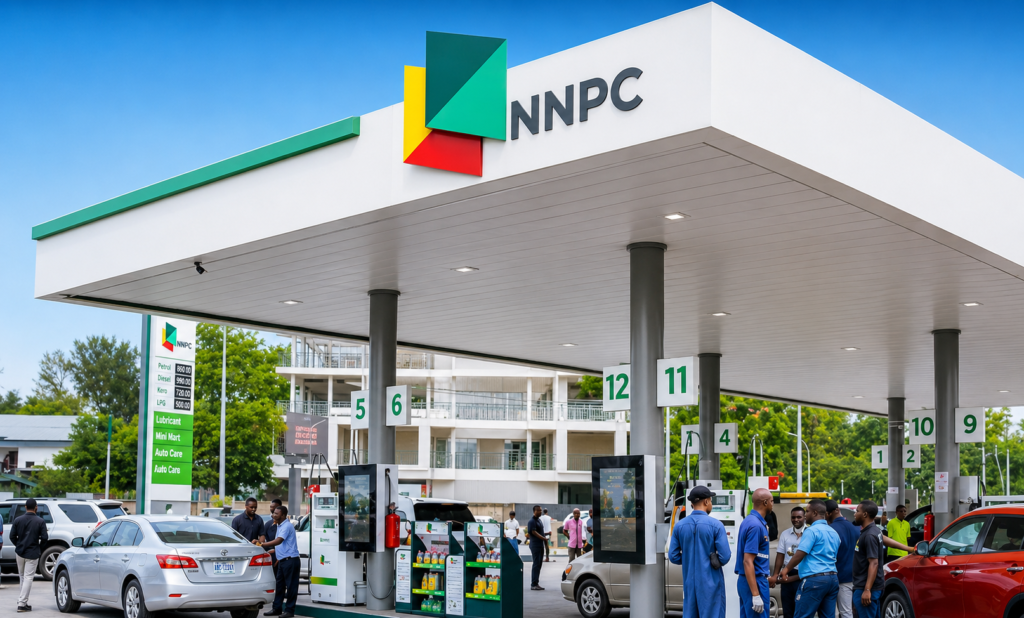
The second downward review in less than two weeks signals a rapidly changing downstream petroleum market, with global crude prices, local refining capacity and deregulation combining to influence pump prices across Nigeria.
Nigerians seeking relief from persistently high transport and living costs received fresh encouragement after the Nigerian National Petroleum Company Limited (NNPCL) reduced the pump price of Premium Motor Spirit (PMS), commonly known as petrol, for the second time in less than two weeks.
Although the reductions are yet to be reflected uniformly across every part of the country, industry observers say the latest move underscores an increasingly competitive downstream petroleum market that differs significantly from the heavily regulated system Nigeria operated for decades.
Market checks conducted at several NNPCL retail outlets indicate that the state-owned energy company has lowered petrol prices by another ₦50 per litre in parts of the Federal Capital Territory, bringing the retail price to about ₦1,210 per litre at some stations, down from ₦1,260. The latest adjustment follows an earlier reduction of about ₦75 per litre announced only days earlier, representing a combined decrease of approximately ₦125 per litre within a short period.
For millions of Nigerians, however, the immediate question extends beyond the announcement itself: will the latest reduction translate into lower transport fares, cheaper food prices and broader economic relief, or will the gains remain largely confined to filling stations?
NNPCL fuel price reduction reflects changing market dynamics
Unlike previous years when pump prices remained largely fixed through government intervention, Nigeria’s downstream petroleum sector now responds more directly to movements in international crude oil prices, foreign exchange conditions, refining costs and competition among marketers.
The latest NNPCL price adjustment comes shortly after the Dangote Refinery reduced its ex-depot petrol price, prompting renewed competition among major marketers. Analysts say this competitive pricing environment has become one of the most visible outcomes of Nigeria’s post-subsidy fuel market.
While NNPCL has not publicly issued a detailed explanation accompanying the latest retail adjustment as of the time of publication, market analysts have linked the reductions to easing international crude oil prices and increasing pressure among fuel suppliers to retain market share.
Falling crude oil prices create room for lower petrol prices
One of the strongest drivers behind the latest reductions is the decline in international crude oil prices.
Recent global oil benchmarks have traded significantly below the elevated levels recorded during heightened geopolitical tensions in the Middle East. Brent crude has hovered around the low-$70 per barrel range, while West Texas Intermediate has traded slightly lower. Lower crude acquisition costs generally reduce refining expenses and ultimately influence retail petrol pricing, although the effect is rarely immediate because inventories purchased at earlier prices must first be exhausted.
Energy economists caution that crude oil remains only one component of petrol pricing.
Exchange rates, shipping costs, insurance, taxes, storage expenses, distribution logistics and marketers’ operating margins also contribute significantly to what motorists eventually pay at filling stations.
Competition between NNPCL and Dangote Refinery is reshaping the downstream sector
Perhaps the most significant development behind recent fuel price adjustments is the emergence of genuine commercial competition.
For decades, NNPCL largely dominated Nigeria’s fuel supply chain through imports and extensive retail infrastructure.
Today, the operational expansion of the Dangote Refinery has introduced another major domestic supplier capable of influencing wholesale prices.
When Dangote reduced its gantry price, marketers immediately recalculated purchasing costs, creating pressure on competing suppliers—including NNPCL—to respond.
Industry experts believe this competitive environment could become more common if multiple domestic refineries operate consistently at commercial capacity.
Instead of government directives determining retail prices, market forces may increasingly shape what consumers pay.
Will Nigerians experience meaningful economic relief?
The latest reductions are undoubtedly welcome news for motorists.
Commercial transport operators, logistics companies, manufacturers and small businesses all rely heavily on petrol either directly or through generators used to compensate for electricity shortages.
Yet history suggests that reductions in pump prices do not automatically produce proportional declines in transportation charges or food prices.
Transport unions often cite maintenance costs, spare parts inflation, tyre prices and general operating expenses when maintaining existing fares even after petrol becomes cheaper.
Food inflation similarly depends on numerous variables beyond fuel costs.
Security challenges affecting agricultural production, poor rural roads, exchange rate pressures, post-harvest losses and storage costs continue to influence market prices across Nigeria.
Consequently, while lower petrol prices may ease inflationary pressures over time, consumers should not necessarily expect immediate reductions across the wider economy.
Fuel subsidy removal continues to shape pricing
The latest adjustment also highlights how dramatically Nigeria’s petroleum pricing structure has evolved since the removal of fuel subsidies.
Before deregulation, government frequently absorbed substantial portions of petrol costs, often spending billions of naira to maintain lower retail prices.
Critics argued that the subsidy regime encouraged inefficiency, smuggling and fiscal leakages, while supporters maintained it protected consumers from volatile international markets.
Following subsidy removal, retail prices have become considerably more responsive to market conditions.
This means prices can increase rapidly during periods of rising crude oil prices or naira depreciation, but they may also decline when market conditions improve.
The current reductions illustrate this new pricing reality.
Exchange rate stability remains crucial
Despite falling crude prices, exchange rate movements continue to represent one of the biggest uncertainties for petrol pricing.
Nigeria still relies on foreign exchange for several components of petroleum operations, including equipment procurement, shipping services and certain refined product transactions.
Should the naira weaken significantly against major international currencies, some of the benefits derived from cheaper crude could diminish.
Conversely, improved exchange rate stability could reinforce downward pressure on fuel prices.
This interaction between foreign exchange markets and petroleum pricing means motorists should expect periodic adjustments rather than permanently fixed prices.
What motorists should expect in the coming weeks
Whether additional reductions occur will depend largely on several interconnected factors.
If international crude oil prices remain relatively low, domestic refining continues expanding, competition among marketers intensifies and exchange rates remain broadly stable, analysts believe further price adjustments cannot be ruled out.
However, petroleum markets remain highly sensitive to global developments.
Unexpected geopolitical tensions, disruptions to oil production, shipping bottlenecks or significant currency volatility could quickly reverse current trends.
For this reason, industry experts advise consumers to view current reductions as market-driven developments rather than guaranteed long-term price levels.
Broader implications for Nigeria’s energy reforms
The latest NNPCL price cut represents more than a temporary reduction at filling stations.
It provides an early indication of how deregulation, domestic refining and commercial competition could gradually reshape Nigeria’s petroleum industry.
If multiple refineries operate efficiently, distribution infrastructure improves and market competition deepens, consumers could benefit from more responsive pricing and greater product availability.
At the same time, policymakers face the challenge of ensuring competition remains fair, transparent and beneficial to consumers while maintaining investment incentives for industry participants.
The effectiveness of Nigeria’s downstream reforms will ultimately be judged not only by pump prices but also by fuel availability, supply reliability, investment growth and their contribution to broader economic stability.
As of the time of publication, the latest NNPCL reductions appear to mark another milestone in the country’s transition from an administratively controlled petroleum market toward one increasingly influenced by commercial competition and global market fundamentals. Whether this evolving landscape delivers sustained benefits for ordinary Nigerians will depend on developments that extend well beyond today’s prices displayed on filling station forecourts.
Author Bio: Smart Chuks is an investigative journalist and policy-focused writer at SaharaNews247, covering Nigerian politics, governance, security, economic developments, public accountability, institutional reform, and international affairs with a focus on transparency, evidence-based reporting, and public interest journalism.

