
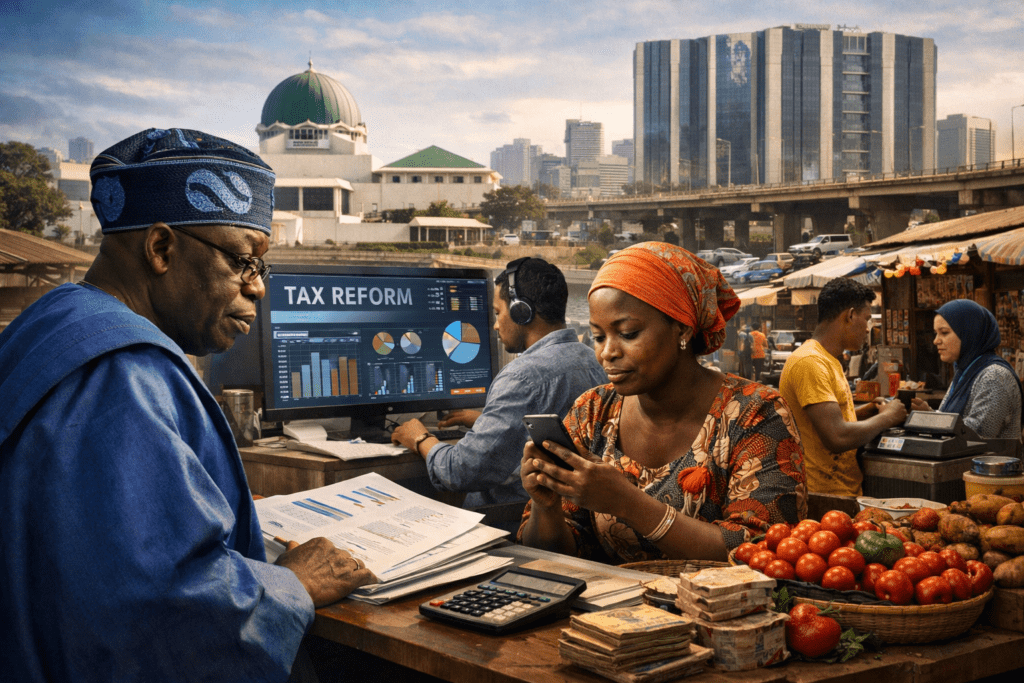
As Nigeria steps deeper into 2026, one issue has quietly moved from the corridors of government into the kitchens, shops and workplaces of ordinary citizens: taxation. From market women in Onitsha to tech founders in Yaba, from civil servants in Abuja to small business owners in Aba, the conversation is the same. Everyone is asking one question in different ways: what exactly do the new tax reforms mean for me?
President Bola Ahmed Tinubu’s administration has launched what is arguably the most ambitious fiscal restructuring Nigeria has seen in decades. Framed officially as a drive to “expand the tax base, reduce dependency on oil revenues and modernise public finance,” the reforms are reshaping how government raises money and how Nigerians experience the state in their daily lives.
For a country where tax compliance has historically been low, public trust in revenue collection is fragile, and informal economic activity dominates, the stakes could not be higher. Done well, tax reform could stabilise government finances, reduce borrowing, and unlock funding for healthcare, education and infrastructure. Done poorly, it could deepen inequality, push more people into poverty, and fuel social unrest.
This is why Tinubu’s tax agenda is not just another economic policy. It is a defining test of governance, legitimacy and political credibility in post-subsidy Nigeria.
Why Nigeria’s Tax System Was Bound to Change
Nigeria’s tax problem did not start with Tinubu. It is the product of decades of structural weakness. Africa’s largest economy has one of the lowest tax-to-GDP ratios in the world, hovering between 7 and 10 percent depending on the year. In practical terms, this means the government collects far less revenue from its economy than most comparable countries.
In South Africa, tax revenue accounts for over 25 percent of GDP. In Kenya, it is about 16 percent. Even Ghana, often considered Nigeria’s smaller peer, does better. Nigeria’s heavy dependence on oil revenue created a system where successive governments neglected domestic taxation, leaving a narrow base of compliant taxpayers carrying the weight of the state.
This imbalance became unsustainable after global oil prices fluctuated, production levels declined, and subsidy costs exploded. By the time Tinubu assumed office, Nigeria was spending more servicing debt than funding critical social services. The removal of fuel subsidy in 2023 signalled a hard truth: the old economic model was broken.
Tax reform became inevitable.
Tinubu’s Fiscal Philosophy: More People, Not Higher Burden
One of the central ideas behind the current reforms is not simply to raise taxes, but to bring more people into the tax net. The administration argues that Nigeria does not necessarily need to tax citizens more aggressively; it needs more citizens to pay something, even if small.
This approach reflects international best practice. A broad tax base creates stability, fairness and predictability. When only a small group pays taxes, they feel exploited and resentful, while the majority remain disconnected from public accountability. When most citizens contribute, even modestly, taxation becomes a shared civic responsibility.
Tinubu’s team, working through the Federal Inland Revenue Service and the Presidential Fiscal Policy and Tax Reforms Committee, has focused on digitisation, data integration, and compliance enforcement. The idea is to reduce leakages, close loopholes, and make it harder to operate entirely outside the tax system.
In theory, this should lead to lower rates in the long run, not higher ones. In practice, many Nigerians fear the opposite.
Key Elements of the New Tax Reforms
Although the reforms are spread across multiple bills, regulations and executive actions, they revolve around several core pillars.
First is the harmonisation of taxes. Nigeria’s tax system has long been criticised for being fragmented, overlapping and confusing. Businesses complain of multiple taxation by federal, state and local authorities. Individuals struggle to understand what they owe and to whom. The reforms aim to streamline tax types, reduce duplication and clarify responsibilities across tiers of government.
Second is digital tax administration. The government is aggressively deploying technology to track income, transactions and economic activity. From bank account linkages to business registration databases, the goal is to create a unified digital identity for taxpayers. This makes it harder to hide income and easier for authorities to detect evasion.
Third is the expansion of the VAT and consumption tax net. Value Added Tax, which currently stands at 7.5 percent, is increasingly becoming a central revenue tool. More goods and services are being captured, especially in the digital economy, logistics, entertainment and professional services.
Fourth is the reform of corporate taxation. Multinational companies, fintech firms, telecoms and large enterprises are facing stricter compliance rules, transfer pricing audits and profit declaration requirements. The message is clear: big businesses must pay their fair share.
Finally, there is increased enforcement against the informal sector. Market traders, artisans, transport operators and small businesses are gradually being registered, documented and taxed through simplified schemes.
This last aspect is the most controversial.
What the Reforms Mean for Salaried Workers
For Nigerians in formal employment, especially in the public and private sectors, taxation is already a reality. Pay-As-You-Earn deductions are routine, and income tax is embedded in monthly salaries.
Under the new regime, the immediate impact on salaried workers is not dramatic in terms of rates. Personal income tax bands remain largely unchanged. However, what is changing is scrutiny and coverage.
More allowances and benefits are now being classified as taxable income. Employers are under pressure to declare full compensation packages, including bonuses, housing benefits and non-cash perks. This reduces opportunities for tax avoidance through creative payroll structures.
At the same time, tax authorities are integrating databases across government agencies. This means discrepancies between lifestyle and declared income are more likely to be flagged. Owning expensive assets, running side businesses or receiving foreign remittances may now attract closer attention.
For many middle-class Nigerians, this feels like being squeezed from both sides. Inflation is high, wages are stagnant, and yet the tax net is tightening. The psychological impact should not be underestimated.
What It Means for Small Businesses and Traders
Perhaps the most sensitive aspect of Tinubu’s reforms is the push into the informal economy. Nigeria’s informal sector accounts for more than 50 percent of GDP and employs the majority of the population. Historically, this sector has operated largely outside the tax system.
Under the new framework, state governments, in collaboration with the federal government, are introducing simplified tax regimes for small businesses. These often involve flat rates, presumptive taxes or digital registration platforms.
For example, a small shop owner may now be required to register with a state tax authority, obtain a digital tax ID, and pay a fixed annual amount based on estimated turnover. Market associations are being used as intermediaries to collect and remit taxes.
Supporters argue that this is fair and necessary. Critics argue that it places additional burden on already struggling entrepreneurs who receive little in return in terms of infrastructure, security or social services.
The deeper issue is trust. Many small business owners are not ideologically opposed to paying taxes. They are practically opposed to paying into a system they believe wastes or steals public funds.
Until governance visibly improves at the grassroots level, compliance will remain fragile.
Impact on the Digital Economy and Freelancers
One of the most significant shifts under Tinubu’s tax reforms is the treatment of the digital economy. Nigeria’s booming tech sector, including freelancers, content creators, online merchants and remote workers, is now firmly on the radar of tax authorities.
Digital platforms are being required to share transaction data. Banks are reporting income flows. Payment processors are cooperating with regulators. In effect, online income is no longer invisible.
For young Nigerians who earn in dollars through freelance platforms, YouTube, crypto or international clients, this is a new reality. Many have never paid taxes before. Some do not even consider themselves part of the Nigerian economy in practical terms.
The government’s position is that income earned by Nigerian residents, regardless of source, is taxable. This aligns with global standards. However, enforcement raises complex questions about jurisdiction, double taxation and financial privacy.
If managed well, this could formalise a new generation of taxpayers and integrate them into the national economy. If managed poorly, it could drive digital workers underground or abroad.
VAT, Prices and the Cost of Living
For ordinary consumers, the most visible tax is VAT. Unlike income tax, VAT is embedded in everyday transactions. It affects food, transport, data, electricity, entertainment and almost everything else.
Since the VAT rate was increased to 7.5 percent, many Nigerians have felt its impact through higher prices. Although VAT is technically paid by businesses, the cost is ultimately passed on to consumers.
Under Tinubu’s reforms, VAT collection is becoming more efficient and comprehensive. More sectors are being captured. More businesses are being audited. This means VAT compliance is rising, even if the rate remains the same.
In a high-inflation environment, this is politically sensitive. Any further increase in VAT would likely trigger public backlash. For now, the government appears cautious about raising rates, focusing instead on expanding the base.
Nevertheless, for households already struggling with food prices, rent and energy costs, even marginal increases feel significant.
Will Tax Reform Reduce Corruption?
One of the strongest arguments in favour of Tinubu’s tax reforms is that a stronger tax system could reduce corruption in the long run. When governments rely heavily on taxes rather than oil rents or borrowing, they become more accountable to citizens.
In theory, taxpayers demand value for money. They ask questions. They vote. They protest. They monitor budgets. This creates pressure for better governance.
In Nigeria’s case, however, the relationship between taxation and accountability has historically been weak. Many Nigerians pay taxes but see little improvement in public services. Corruption scandals continue. Infrastructure remains poor.
The success of the current reforms will depend not just on how much revenue is collected, but on how transparently it is used. Without visible improvements in roads, schools, hospitals and security, tax compliance will remain grudging at best.
Political Risks and Social Tensions
Tax reform is never politically neutral. It redistributes costs and benefits across society. It creates winners and losers. It touches on sensitive issues of class, privilege and power.
In Nigeria’s deeply unequal economy, the perception that the poor are being taxed more aggressively than the rich could fuel resentment. If market traders are harassed while politically connected elites evade taxes, the legitimacy of the entire system collapses.
There are already signs of tension. In some states, traders have protested against new tax levies. In others, transport unions have resisted digital ticketing systems. Online, freelancers complain about being targeted without adequate guidance.
The government must tread carefully. Enforcement without education breeds hostility. Compliance without trust breeds evasion.
The Bigger Picture: Nigeria’s Economic Survival
Beyond the immediate controversies, Tinubu’s tax reforms are part of a larger economic survival strategy. Nigeria’s debt levels are rising. Foreign reserves are under pressure. Oil revenue is unreliable. Subsidies have been removed. The old fiscal model is dead.
Without a functioning domestic tax system, Nigeria cannot fund its development sustainably. It will remain trapped in cycles of borrowing, austerity and crisis.
Tax reform is therefore not optional. It is existential.
The real question is not whether Nigerians should pay more taxes. The real question is whether the Nigerian state can finally become worthy of those taxes.
What Ordinary Nigerians Should Expect Going Forward
In the short term, more Nigerians will feel the presence of tax authorities in their lives. Registration, documentation and digital tracking will increase. Informality will become harder to maintain.
In the medium term, businesses will face stricter compliance requirements. Digital income will be taxed more systematically. VAT will be more consistently collected.
In the long term, if the reforms succeed, Nigeria could achieve a more stable, predictable and equitable fiscal system. Government may rely less on borrowing. Public services may improve. Trust may slowly rebuild.
But none of this is automatic. Policy design is only half the story. Implementation, transparency and political will are what ultimately determine outcomes.
A Defining Moment for Tinubu’s Presidency
Tinubu’s tax reforms will likely outlive his presidency. They are structural, not cosmetic. They reshape the relationship between citizens and the state.
If successful, they could be remembered as the foundation of Nigeria’s modern fiscal state. If they fail, they could deepen poverty, fuel unrest and discredit future reform efforts.
For ordinary Nigerians, the reforms mean one thing above all: the era of economic invisibility is ending. Whether this leads to shared prosperity or shared frustration depends on what the government does next.
Tax, in the end, is not just about money. It is about trust. And trust remains Nigeria’s most fragile resource.
Author Bio
Smart Chuks is a Nigerian investigative journalist and media analyst with a focus on governance, political economy and public policy. He writes for SaharaNews247, where he covers national affairs, institutional reforms and socio-economic trends shaping Nigeria and Africa.

