By Chika Okafor, SaharaNews247
Published: October 4, 2025
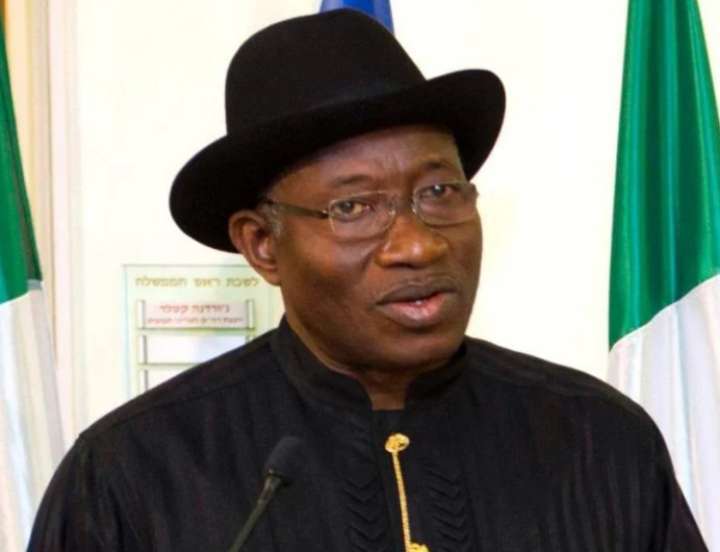
Former Nigerian President Goodluck Ebele Jonathan has firmly denied claims that he ever accused former President Muhammadu Buhari of having ties with the Boko Haram terrorist group, describing the allegations as “a deliberate attempt to twist history and mislead the public.”
Jonathan, who led Nigeria from 2010 to 2015, addressed the issue after renewed online circulation of old statements suggesting that he once blamed Buhari and the northern political elite for sponsoring Boko Haram. In his latest reaction, Jonathan said those claims are false, malicious, and designed to stir political tension ahead of the 2027 general elections.
The Origin of the Allegation
The controversy resurfaced on social media platforms where fabricated screenshots and edited video clips purportedly showed Jonathan accusing Buhari of being behind Boko Haram’s rise during his administration.
However, checks by SaharaNews247 and independent fact-checking organizations such as Dubawa and AFP Fact Check confirmed that the quotes and videos were either taken out of context or completely fabricated.
Jonathan clarified through his media office that he never made such statements, emphasizing that during his presidency, he consistently sought unity, peace, and cooperation among all political actors to fight terrorism.
“I never at any point accused former President Buhari of sponsoring Boko Haram. Nigerians should disregard such falsehoods and understand that these are recycled lies aimed at smearing my name and sowing discord,” Jonathan’s spokesperson said.
Political Manipulation and the Power of Misinformation
Political misinformation has long been a tool in Nigeria’s democratic space. From the 2015 elections to today, both major parties — the PDP and APC — have accused each other of using propaganda to gain political mileage.
Analysts believe the resurfacing of this claim is not coincidental. With the 2027 general elections drawing near, misinformation is increasingly being used to discredit political figures and shape public perception.
Dr. Ifeanyi Agbaje, a political communication expert, told SaharaNews247 that misinformation campaigns are often designed to evoke emotional responses among voters.
“Social media has made it easy for falsehoods to spread faster than truth. Once a fake narrative takes hold, it can influence millions before fact-checkers intervene,” he explained.
Jonathan’s Track Record on Counter-Terrorism
Under Jonathan’s administration, Boko Haram reached its most violent peak, carrying out deadly bombings in Abuja, Kano, Maiduguri, and other cities. However, his government also laid the groundwork for regional collaboration that eventually weakened the insurgents.
In 2013, Jonathan established a Joint Task Force (JTF) and sought cooperation with neighboring countries like Chad, Cameroon, and Niger to combat terrorism in the Lake Chad Basin. His administration also introduced the Safe Schools Initiative after the Chibok girls’ abduction, which drew global attention.
Though critics argue that Jonathan was slow to act initially, others acknowledge that his government faced immense pressure and limited intelligence coordination at the time.
Buhari’s Role and the Political Fallout
When Buhari took office in 2015, he made the fight against Boko Haram a top priority. His administration claimed major successes, reclaiming territories once held by insurgents. Yet, the group evolved into factions, including ISWAP (Islamic State West Africa Province), prolonging insecurity in Nigeria’s northeast.
The perceived rivalry between Jonathan and Buhari remains a touchstone of Nigeria’s modern political history. Both men symbolize two contrasting eras — one marked by democratic goodwill but weak military control, and the other defined by strong rhetoric on security but lingering human rights concerns.
Jonathan’s recent clarification, therefore, seeks to close a chapter of blame games and historical distortions.
Fact-Checking the Viral Claims
A review by SaharaNews247 found that most of the viral claims linking Jonathan to statements against Buhari came from edited excerpts of old interviews, particularly one aired on BBC Hausa in 2014. In that interview, Jonathan did not accuse Buhari directly but expressed concern that certain political figures were “making unguarded statements capable of emboldening insurgents.”
Independent fact-checkers concluded that the online versions circulating in 2025 were doctored to make it seem like Jonathan pointed fingers at Buhari personally — a claim unsupported by any credible record.
Public Reaction
Nigerians on social media have expressed mixed reactions. Some users applauded Jonathan’s clarification, describing him as “a statesman who refuses to be drawn into needless controversies.” Others questioned the timing of his statement, suggesting it may be politically motivated as the 2027 election season intensifies.
An X (formerly Twitter) user wrote:
“Jonathan has every right to defend his legacy. Too many lies have been spread about his time in office.”
Another user countered:
“Why speak now? People have believed this for years. Maybe he’s preparing for something political.”
The mixed sentiments reflect Nigeria’s polarized political atmosphere, where trust in public figures remains deeply divided.
Media Responsibility and the Need for Truth
The episode underscores the crucial role of responsible journalism in safeguarding democracy. Experts argue that media outlets must prioritize verification over virality and educate the public on recognizing fake news.
Professor Zainab Bello, a media ethics scholar, emphasized that media literacy is essential in preventing manipulation.
“Fake news thrives in environments where critical thinking is weak. We must teach citizens how to identify doctored images, misleading headlines, and misattributed quotes,” she said.
Jonathan’s response also demonstrates the growing need for politicians to directly engage with misinformation. Unlike in the past, silence now often fuels speculation.
Historical Context: The Politics of Boko Haram
The Boko Haram insurgency has always had a political dimension. Initially founded in 2002 by Mohammed Yusuf, the group’s ideology centered on rejecting Western education and governance. After Yusuf’s death in 2009, the group turned violent under Abubakar Shekau, launching deadly attacks across Nigeria.
During Jonathan’s tenure, some political opponents accused his government of using Boko Haram as an excuse to suppress the North, while others alleged northern leaders supported the insurgency to weaken his presidency. Both claims remain unproven.
The cycle of accusation, denial, and counter-accusation has since become a recurring theme in Nigeria’s fight against terrorism — often distracting from the root causes like poverty, illiteracy, and corruption.
What This Means for Nigeria’s Democracy
Jonathan’s latest statement may seem like a personal clarification, but it carries wider implications for Nigeria’s political discourse. It reminds the public that truth and context matter, especially in an age where misinformation can shape national narratives overnight.
As the nation approaches the 2027 general elections, political actors, journalists, and voters alike must confront the dangers of fake news and the deliberate rewriting of history.
Dr. Tunde Olofin, a political historian, noted that Nigeria’s democratic stability depends on information integrity.
“When fake news drives political behavior, democracy suffers. It leads to division, violence, and mistrust in institutions,” he warned.
Jonathan’s denial, therefore, is not just a rebuttal of a false story — it’s a call for accountability in political communication.
Conclusion
The resurfacing of the false claim that former President Goodluck Jonathan accused Muhammadu Buhari of sponsoring Boko Haram highlights the persistent challenge of misinformation in Nigerian politics.
In a digital era where falsehoods spread faster than facts, Jonathan’s proactive clarification demonstrates the importance of preserving truth and credibility in governance.
As Nigerians prepare for another election cycle, it becomes even more critical for the public to question viral claims, verify sources, and prioritize credible journalism over politically motivated narratives.
Only through truth and responsible media can Nigeria safeguard its democracy from the weaponization of lies.
Author Bio
Chika Okafor is a political analyst and journalist with SaharaNews247, focusing on governance, public policy, and digital misinformation in Africa. With over a decade of experience in investigative reporting, Chika is passionate about promoting fact-based journalism and strengthening Nigeria’s democratic values.