Chaos at INEC Headquarters as Protest Erupts Over Labour Party’s Exclusion from August Bye-Elections
Date: August 6, 2025
By: SaharaNews247 Political Desk
Protesters Storm INEC in Abuja Over Labour Party’s Candidate Exclusion
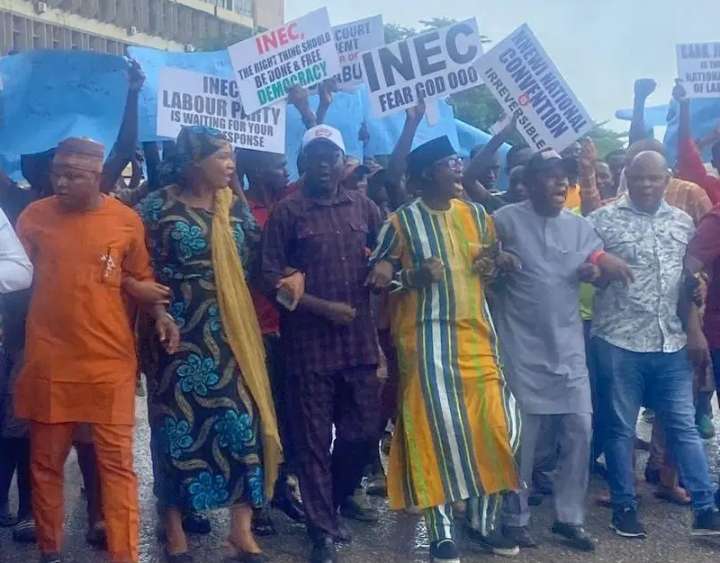
Nigeria’s political scene was thrown into fresh turmoil on Tuesday, August 6, 2025, as hundreds of protesters stormed the Abuja headquarters of the Independent National Electoral Commission (INEC). The protest was led by individuals and civil society groups aligned with the Julius Abure-led faction of the Labour Party (LP).
Their demand was clear: INEC must reverse its decision to exclude their faction’s candidates from the upcoming nationwide bye-elections scheduled for August 16, 2025.
Chanting slogans and waving placards that read “INEC Must Obey Court Orders” and “Stop Killing Democracy,” the protesters accused INEC of bias, suppression, and undermining democratic participation.
Understanding the Labour Party Power Struggle
The protest is the latest chapter in a bitter leadership crisis that has plagued the Labour Party. The tension centers on two rival factions:
Julius Abure, who claims grassroots and structural legitimacy
Nenadi Usman, who is legally recognized by the Supreme Court as the current National Chairman
In April 2025, the Supreme Court ruled that Julius Abure’s tenure expired on June 8, 2023, thereby upholding the emergence of Nenadi Usman as the lawful national leader. However, Abure has continued to operate a parallel structure, nominating candidates for elections, including those for the August 2025 bye-polls.
INEC’s Decision Sparks Backlash
INEC’s publication of the list of cleared candidates for the August 16 bye-elections made no mention of individuals submitted by the Abure faction. That decision infuriated supporters, many of whom now believe the electoral body is actively trying to silence opposition voices.
During the protest, several speakers accused INEC of undermining democracy by denying Nigerians the right to choose from all legitimate political voices.
One protester stated, “INEC is behaving like a political actor, not an impartial umpire. If this bias continues, it will damage public confidence in Nigeria’s elections.”
Labour Party Officially Disowns the Protest
While the Abure-led supporters demonstrated outside INEC, the recognized leadership of the Labour Party, under Nenadi Usman, quickly released a public statement disassociating the party from the protest.
In the official release, the Usman-led faction stated:
“The protest at INEC headquarters was not authorized by the Labour Party. Those involved are impostors. Security agencies should take action against those misrepresenting the party’s leadership and court rulings.”
This position reflects the ongoing legal battle for legitimacy within the party and reinforces the Supreme Court’s earlier decision.
Legal and Electoral Implications
This incident raises fundamental questions about the intersection of law, politics, and electoral integrity in Nigeria. INEC’s stance, while legally consistent with the Supreme Court ruling, risks escalating public tensions if large sections of the electorate feel excluded.
Legal experts suggest that continued defiance by the Abure group may result in:
Prolonged legal challenges post-election
Voter apathy due to perceived manipulation
Damaged institutional trust in INEC and the judiciary
Dr. Aminu Yakubu, a constitutional lawyer, said, “The rule of law is under stress. If INEC and the courts cannot enforce compliance, then Nigeria’s democracy risks descending into chaos.”
Why the August 2025 Bye-Elections Matter
The upcoming bye-elections will fill legislative seats across key states including Lagos, Imo, Kogi, Benue, Rivers, and Plateau. These elections are seen as a critical litmus test for the 2027 general elections.
A strong performance from opposition parties could shift national momentum, making the exclusion of candidates from one of Nigeria’s top three parties even more politically significant.
Political Analysis: The Real Cost of Internal Division
The Labour Party’s internal crisis demonstrates how disunity within opposition parties can weaken democracy. Instead of focusing on policy and national development, valuable energy is lost in legal wrangling and factional disputes.
This ongoing battle has implications beyond the bye-elections. It could:
Alienate supporters who feel confused or betrayed
Weaken Labour Party’s structure ahead of the 2027 elections
Provide political leverage to ruling parties
If unresolved, the Abure–Usman crisis may cripple the party’s national strategy and reduce its competitiveness at the federal level.
Public Voices from the Protest
Several protesters voiced strong opinions during the Abuja demonstration.
Ngozi Uche, a youth activist, said, “We voted for the Labour Party in 2023 because we believed in its vision. INEC cannot silence our voices now. Democracy must work for everyone.”
Another protester, Bashir Lawal, added, “If INEC can ignore valid nominations, what stops them from manipulating results during the elections?”
What’s Next?
With the bye-elections just days away, INEC faces growing pressure to clarify its position and ensure that all its actions align with the law, court orders, and democratic ethics.
At the same time, both Labour Party factions must decide whether to continue their legal war or find a political solution that prevents the party from disintegrating further.
Labour Party protest INEC
INEC excludes Labour Party candidates
Julius Abure Labour Party
Nenadi Usman Supreme Court Labour Party ruling
INEC Abuja protest August 2025
Bye-elections Nigeria 2025
INEC candidate list exclusion
Nigerian politics 2025
Labour Party internal crisis
INEC electoral controversy
Conclusion
The protest at INEC headquarters is a stark reminder that Nigeria’s democracy remains fragile. As long as internal party disputes go unresolved and court orders are treated as suggestions rather than mandates, electoral stability will continue to be threatened.
As the August 16 bye-elections approach, Nigerians will be watching not only the ballot but also the behaviors of key institutions. Will the Labour Party recover its unity? Can INEC restore public trust? And most importantly, will Nigeria’s democracy survive its latest test?