
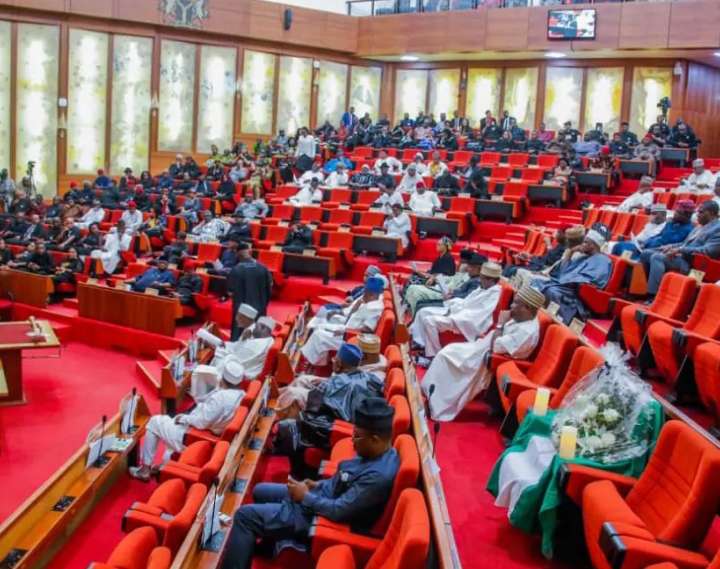
Abuja — When the Nigerian Senate reconvened for Tuesday’s plenary to consider amendments to the Electoral Act ahead of the 2027 general elections, what unfolded inside the red chamber was more than a legislative disagreement. It was an early contest over the architecture of Nigeria’s next transfer of power.
At issue were two politically sensitive questions: whether the 2027 election timetable should be adjusted in light of religious calendar considerations, and whether electronic transmission of results should be made legally mandatory without qualification. Beneath those questions lay a deeper struggle — how Nigeria balances technological reform with infrastructural limitations, constitutional precision with political trust, and judicial precedent with legislative ambition.
The debate, described by participants as tense and sharply divided, signals that the integrity of the 2027 elections will be shaped as much by legal drafting today as by campaign dynamics tomorrow.
The Legislative Context: Why the Electoral Act Is Back Under Review
Nigeria’s electoral process is currently governed by the Electoral Act 2022, enacted ahead of the 2023 general elections. The law was widely regarded at the time as reform-oriented legislation, particularly for strengthening provisions on electronic accreditation and result management.
Section 50 of the Act empowers the Independent National Electoral Commission (INEC) to determine the procedure for voting and transmission of results. Section 60 provides that presiding officers shall transfer results, including by electronic means, in a manner prescribed by the Commission. However, the Act does not explicitly elevate electronically transmitted results above manually completed polling unit result sheets in legal hierarchy.
During the 2023 general elections, INEC deployed the Bimodal Voter Accreditation System (BVAS) for voter verification and introduced the INEC Result Viewing Portal (IReV), which allowed polling unit results to be uploaded digitally for public viewing. While the National Assembly elections saw relatively smoother uploads, the presidential election experienced delays in real-time transmission to the portal, prompting criticism and post-election litigation.
Although the Supreme Court ultimately upheld the presidential election results, its reasoning clarified that the primary legally admissible documents remained the manually signed polling unit result sheets, not the electronic portal uploads. That interpretation now casts a long shadow over the Senate’s amendment debate.
Tuesday’s plenary must therefore be understood against that judicial backdrop.
The 2027 Election Timetable: Constitutional Windows and Religious Sensitivities
Under Section 132 of the 1999 Constitution (as amended), presidential elections must be conducted not earlier than 150 days and not later than 30 days before the expiration of the incumbent president’s term. Since the current presidential tenure expires on May 29, 2027, the constitutional window places the next presidential election in February 2027.
INEC has traditionally scheduled presidential and National Assembly elections within that February window. However, concerns were raised during the Senate session that the projected election period may coincide with Ramadan.
Several senators reportedly argued that conducting nationwide elections during a major religious observance could affect voter turnout in predominantly Muslim communities and complicate logistics for electoral officials observing the fast.
Others countered that INEC’s constitutional mandate allows it to determine dates within the prescribed window and that legislative interference could introduce administrative uncertainty. They noted that Nigeria has previously conducted elections close to religious periods without systemic disruption.
The debate reflects Nigeria’s plural society, where electoral scheduling inevitably intersects with religious, cultural and regional considerations. While no sweeping alteration to the constitutional timeline was adopted, the discussion signals that the final 2027 timetable may yet be refined to avoid avoidable socio-religious friction.
Electronic Transmission: The Core Legal Fault Line
The more consequential battle concerned electronic transmission of results.
In the 2023 election petitions, opposition parties argued that INEC’s failure to upload presidential results to the IReV portal in real time constituted a violation of the Electoral Act. INEC maintained that while electronic transmission was authorised, it was not an absolute legal condition for valid result declaration.
The Presidential Election Petition Tribunal, and later the Supreme Court, held that the Electoral Act did not make electronic transmission mandatory in a manner that would invalidate manually collated results. The courts emphasised that polling unit result sheets — particularly Form EC8A — remained the foundational documents for collation and judicial review.
This interpretation has shaped legislative caution.
During Tuesday’s plenary, some lawmakers sought stronger statutory language that would elevate electronic transmission to a binding requirement, thereby eliminating ambiguity before 2027. They argued that public trust in elections now depends heavily on transparent digital processes and that any fallback provision risks perpetuating vulnerabilities historically associated with manual collation stages.
Opposing senators warned that Nigeria’s telecommunications infrastructure remains uneven. With more than 176,000 polling units nationwide, many located in rural areas with limited connectivity, they argued that making electronic transmission the sole legally recognised method could expose the electoral process to technical disruptions beyond INEC’s control.
After debate and reported division, the Senate retained a compromise provision: electronic transmission remains affirmed and lawful, but manually completed polling unit result sheets remain valid and legally operative where electronic systems fail.
Contrary to claims circulating in some political commentary, the Senate did not abolish electronic transmission. It declined to make it exclusive and overriding without contingency.
Infrastructure Realities: The Digital Divide Question
Nigeria’s telecommunications penetration has improved significantly over the past decade, yet coverage gaps remain, particularly in remote communities. Network congestion during high-traffic events further complicates reliability.
INEC’s 2023 experience demonstrated the challenges of scaling digital uploads simultaneously across thousands of polling units. While BVAS accreditation largely functioned as designed, the IReV portal encountered delays in presidential result uploads, though those delays did not prevent physical collation at ward and state levels.
Supporters of retaining manual fallback argue that a legal framework must account for real-world infrastructure. Critics counter that technological shortcomings should be resolved before elections rather than accommodated by legal ambiguity.
This tension defines the Senate’s cautious posture: a hybrid model prioritising redundancy rather than exclusivity.
Lessons from Comparative Democracies
Globally, election management bodies employ hybrid systems that combine digital transmission with physical audit trails. In Kenya’s 2017 and 2022 elections, for example, electronic transmission was central to transparency efforts, yet courts relied heavily on physical forms when adjudicating disputes. Ghana similarly employs scanned result uploads while maintaining physical collation documents as primary evidence in litigation.
The broader democratic principle is redundancy — ensuring that no single technological or manual layer determines electoral legitimacy in isolation.
Nigeria’s framework, as preserved by the Senate’s current amendment approach, aligns with this hybrid model, though critics argue that clearer statutory prioritisation of electronic transmission would better align with reformist aspirations.
Political Implications Ahead of 2027
The amendment debate carries strategic implications.
Opposition parties are likely to frame any perceived dilution of electronic transmission as a retreat from transparency. The ruling party and its allies may argue that infrastructural pragmatism prevents unnecessary litigation and protects votes from technical nullification.
Civil society organisations that monitored the 2023 elections have consistently advocated for unambiguous legal standards to prevent interpretive disputes. Their engagement in the ongoing amendment process is expected to intensify.
Beyond partisan positioning lies a deeper institutional question: how to design an electoral system resilient enough to withstand both technological strain and political contestation.
Electoral Risk Mapping for 2027
Several scenarios emerge from the Senate’s compromise.
If INEC significantly upgrades network coordination and server capacity before 2027, electronic transmission could function more seamlessly, reducing reliance on manual fallback.
If infrastructural constraints persist, hybrid redundancy may prove prudent.
If political actors continue to contest the legal hierarchy between digital and manual records, further judicial interpretation may again shape post-election outcomes.
The Senate’s decision does not end the debate. It frames it.
Public Trust and Democratic Stability
Nigeria’s electoral history has oscillated between reform and controversy. Public confidence remains fragile, particularly after highly litigated elections.
Transparency advocates argue that visible, real-time digital uploads reduce suspicion and empower citizens. Institutional realists caution that overpromising technological guarantees without infrastructural backing risks deeper distrust.
Ultimately, public trust will depend less on statutory phrasing than on credible implementation.
The Legislative Path Forward
The amendment must pass both chambers of the National Assembly and receive presidential assent to become law. Committee harmonisation may yet refine language before final passage.
INEC, meanwhile, continues preparations through off-cycle elections, which serve as operational testing grounds for refined procedures.
Between now and early 2027, Nigeria’s electoral ecosystem will undergo scrutiny not only from politicians, but from courts, civil society groups and international observers.
A Defining Moment for Electoral Reform
Tuesday’s Senate plenary was dramatic not because of raised voices, but because of what it represents: an early struggle over the rules that will govern Nigeria’s next democratic transition.
The Senate neither dismantled electronic transmission nor elevated it to unquestionable supremacy. Instead, it embraced a cautious compromise rooted in judicial precedent and infrastructural realism.
Whether that compromise strengthens or complicates Nigeria’s democratic journey will depend on how faithfully institutions implement the law, how transparently processes are managed, and how responsibly political actors conduct themselves in the months leading to 2027.
As Nigeria approaches another defining election, the debate inside the Senate underscores a fundamental truth: democracy is not secured by technology alone, nor by paper documentation alone, but by the integrity of the institutions that administer both.
About the Author
Smart Chuks is a senior political correspondent and investigative journalist with SaharaNews247. His reporting focuses on electoral reform, constitutional governance, legislative accountability and democratic institutions across Nigeria and West Africa. He delivers fact-driven, institutionally grounded analysis designed to inform public understanding and policy debate.